eBay listing fees are one of the most misunderstood costs on the platform — many sellers assume every listing costs money, when in reality most casual sellers pay nothing at all. Most sellers never pay eBay listing fees because of the monthly free listing allowance. However, once you exceed your free listings, eBay charges an insertion fee. Understanding eBay listing fees properly means knowing exactly when they kick in, how they’re charged, and how they differ from country to country and from eBay’s other main cost, the final value fee.
This guide covers eBay listing fees for the US, UK, Canada, and Australia in one place — free listing allowances, insertion fee amounts, what happens once you exceed your free limit, and how listing fees compare to final value fees. Want to see your total eBay costs instantly? Use our free eBay Fee Calculator — it covers all four countries.
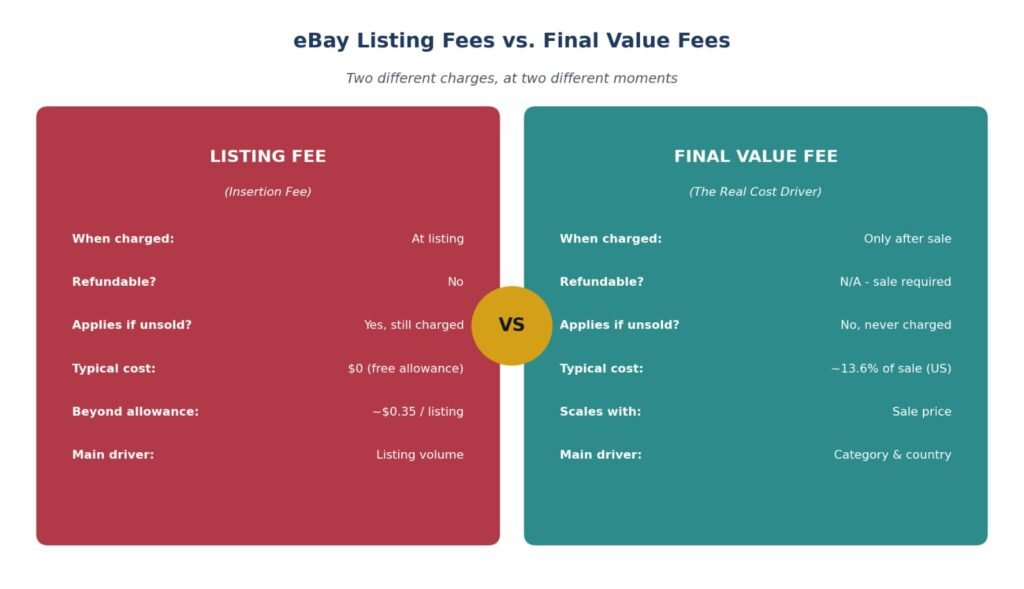
Table of Contents
What Are eBay Listing Fees?
How eBay Listing Fees Work
eBay Free Listings Explained
eBay Insertion Fees Explained
eBay Listing Fees USA
eBay Listing Fees UK
eBay Listing Fees Canada
eBay Listing Fees Australia
eBay Listing Fees: Country Comparison Table
How to Avoid eBay Listing Fees
eBay Listing Fees vs Final Value Fees
Frequently Asked Questions
What Are eBay Listing Fees?
eBay listing fees are what most sellers mean when they ask “what are eBay listing fees” — they’re the charges eBay can apply simply for putting an item up for sale, separate from what eBay takes once the item actually sells. On eBay, this specific charge is officially called the insertion fee, and for the vast majority of sellers, it’s zero — thanks to a generous free monthly listing allowance.
The key thing to understand upfront: eBay listing fees and final value fees are two completely different charges that apply at two different moments. Listing fees apply (if at all) the moment you create a listing. Final value fees apply only after an item sells. We’ll cover exactly how these two interact later in this guide.
This distinction matters more than it might first appear, because it shapes how you should think about risk when listing. A final value fee is, in a sense, a “good problem” — you only pay it because you made a sale. A listing fee, by contrast, is a cost you can incur with nothing to show for it: if an item never sells and you’ve exceeded your free allowance, that insertion fee is gone regardless of outcome. Recognizing which of the two you’re actually worried about — the cost of trying to sell versus the cost of succeeding — is the first step to managing eBay fees intelligently rather than reactively.
How eBay Listing Fees Work
The Basic Mechanics
Every time you create a listing, eBay checks it against your monthly free listing allowance. If you’re under the limit, the listing costs nothing. If you’re over it, an insertion fee is charged — regardless of whether the item ever sells. This is the single most important thing to understand about how much are eBay listing fees in practice: unlike the final value fee, the insertion fee is charged upfront and is non-refundable.
What Counts Against Your Allowance
A few mechanics catch new sellers off guard:
Per category, not per item — if you list the same item in two categories, that counts as two listings against your allowance
Relisting counts again — if an item doesn’t sell and you relist it, that’s a new insertion, consuming another free slot or triggering a new fee
“Good ‘Til Cancelled” listings renew monthly — each automatic renewal counts as a fresh listing against that month’s allowance.
A Worked Example
Say you’re a US seller with no Store subscription who lists 280 items in a calendar month. Your first 250 listings are free. The remaining 30 listings each trigger the $0.35 insertion fee — that’s $10.50 in listing fees for the month, entirely separate from whatever final value fees apply once those items actually sell. If you’d stayed at or under 250 listings that month, your listing-related cost would have been $0, regardless of how many of those items sold.
This example illustrates why tracking your active listing count matters more than tracking individual item prices when it comes to managing listing fees specifically — the insertion fee cares about volume, not value.
eBay Free Listings Explained
How many free listings does eBay give? For most non-Store sellers in the US, eBay provides 250 free listings per month, resetting at the start of each calendar month. This allowance applies across most categories (a small number of categories are excluded from the free allowance — always check eBay officials insertion fee schedule category-specific rules before listing high volumes there).
If you subscribe to an eBay Store, your free listing allowance increases significantly:
Starter Store: 250 free listings (same as no Store, but with $0.30 insertion fee after, vs. $0.35 without a Store)
Basic Store: 1,000 free listings/month
Premium Store: 10,000 free listings/month
Anchor Store: 25,000 free listings/month
For the overwhelming majority of casual and part-time sellers, this free allowance means eBay listing fees for beginners are effectively zero — the real cost driver is the final value fee once something sells.
It’s worth emphasizing just how high this bar actually is for a typical seller. Listing 250 items in a single month means creating roughly 8 new listings every single day, seven days a week — a pace far beyond what most casual sellers, and even many dedicated part-time resellers, will ever hit. For context, a seller clearing out a garage, downsizing a collection, or flipping items as a side income stream typically lists somewhere between 5 and 40 items a month. That leaves an enormous buffer before the free allowance becomes a real constraint, which is exactly why so many sellers are surprised to learn eBay charges a listing fee at all — for most of them, in practice, it never actually applies.
eBay Insertion Fees Explained
What Happens After You Exceed the Free Allowance
Once you exceed your monthly free listing allowance, the eBay insertion fee kicks in — $0.35 per listing in most categories for non-Store sellers (or $0.30 with a Starter Store). This is charged the moment you create the listing, win or lose.
Why This Matters More Than It Seems
Because insertion fees are non-refundable and apply per listing and per category, they compound quickly for high-volume sellers who exceed their allowance. A seller listing 350 items in a month with no Store subscription would pay the insertion fee on 100 of those listings — that’s $35, even before a single item sells. This is exactly the kind of cost a Store subscription is designed to eliminate.
Not sure where your own listing volume puts you? Run your numbers through the eBay Fee Calculator to see your exact insertion and final value fee costs side by side.
eBay Listing Fees USA
For US sellers, the listing fee structure is straightforward: 250 free listings per month (non-Store), then $0.35 per additional listing in most categories. This applies equally to private and business-type accounts — the US doesn’t distinguish between casual and business sellers for fee purposes the way the UK does.
In practice, this means the overwhelming majority of US sellers — anyone running a garage-sale-style side hustle, a reselling hobby, or even a moderately active part-time store — will simply never see an insertion fee on their account statement. The 250-listing threshold is generous enough that it only becomes a real planning consideration once you’re operating closer to a full-time volume seller, typically someone actively managing several hundred SKUs at once with regular relisting activity.
Where US sellers most commonly trip the insertion fee without realizing it is through duplicate-category listings and aggressive relisting cycles. If you’re testing the same product across two categories to see which converts better, that’s two insertion-fee-eligible listings, not one — and if you’re using automated relisting tools that renew unsold items every few days rather than letting them run their full duration, you can burn through your 250-listing allowance far faster than expected. Reviewing your Seller Hub’s listing activity monthly is the simplest way to catch this before it becomes a real cost.
eBay Listing Fees UK
UK sellers get a slightly larger free allowance: 300 free listings per month, compared to 250 in the US. Beyond that allowance, an insertion fee applies per listing, similar in structure to the US model.
The more important UK-specific distinction isn’t the listing fee — it’s what happens after the sale. As covered in our companion guide on eBay selling fees, UK private sellers currently pay no final value fee at all, while UK business sellers pay a category-based rate plus VAT. Listing fees themselves don’t carry this private-vs-business distinction — the 300 free listings and subsequent insertion fee apply the same way regardless of seller type.
This creates an interesting practical dynamic for UK sellers specifically: because the listing fee structure is seller-type-agnostic but the final value fee structure isn’t, a UK private seller’s total cost profile looks almost nothing like a UK business seller’s, even though both are working from the same 300-listing free allowance. A private seller clearing out a wardrobe faces essentially zero eBay costs unless they list beyond 300 items a month. A VAT-registered UK business seller, by contrast, needs to budget for the final value fee and VAT on every single sale regardless of listing volume — meaning the listing fee is genuinely the smaller of their two cost concerns, while for the private seller, it’s effectively the only cost concern that matters.
eBay Listing Fees Canada
eBay Canada follows a structure very close to the US model: 250 free listings per month for non-Store sellers, with an insertion fee applying per listing beyond that allowance, charged in Canadian dollars. Like the US, this allowance resets at the start of each calendar month and applies broadly across most categories, though a small number of specialty categories carry their own listing rules — always check the category page before bulk-listing in something unfamiliar.
Store subscription tiers work the same way in Canada as they do in the US: subscribing to a Basic, Premium, or Anchor Store increases your monthly free listing allowance well beyond 250, and typically lowers your per-listing insertion fee for anything beyond that expanded allowance. For Canadian sellers running a part-time or side-hustle operation, staying under 250 active listings a month means insertion fees essentially never come into play — the final value fee remains the real cost driver, just as it does in the US and Australia.
One detail Canadian sellers sometimes overlook: because eBay.ca fees are charged and displayed in CAD, it’s worth double-checking your Seller Hub reports in local currency rather than assuming figures quoted in US-focused guides convert one-to-one. The percentage structures are close, but exchange rate movements mean your actual CAD insertion fee can drift slightly over time even if eBay hasn’t changed its published rate. Running your numbers through a calculator that supports CAD directly removes this guesswork.
eBay Listing Fees Australia
eBay Australia also mirrors the US structure: 250 free listings per month, with a per-listing insertion fee (charged in AUD) once you exceed that allowance. As with Canada, category exclusions can apply, so high-volume sellers in specific categories — collectibles and certain auto parts categories are common examples — should confirm their exact allowance before listing in bulk.
Australian sellers benefit from the same Store subscription logic as the US and Canada: moving to a Basic Store or above significantly raises your free listing ceiling and can reduce the insertion fee on anything beyond it. Given that Australia’s ecommerce seller base skews toward a mix of hobbyist resellers and small registered businesses, it’s worth explicitly separating your listing strategy by seller type. Hobbyist sellers rarely need to think about insertion fees at all, provided they keep active listings under the free threshold each month. Registered business sellers running higher SKU counts, on the other hand, should treat the 250-listing mark as a planning checkpoint — the moment monthly listings start regularly exceeding it, a Store subscription typically pays for itself through the combination of expanded free listings and the final value fee discount that comes with it.
As with Canada, AUD-denominated fees can shift slightly relative to USD-focused fee guides due to currency movements, so Australian sellers should rely on AUD-native figures — either from eBay’s own Seller Hub or a calculator built to handle local currency — rather than converting US dollar figures manually.
eBay Listing Fees: Country Comparison Table
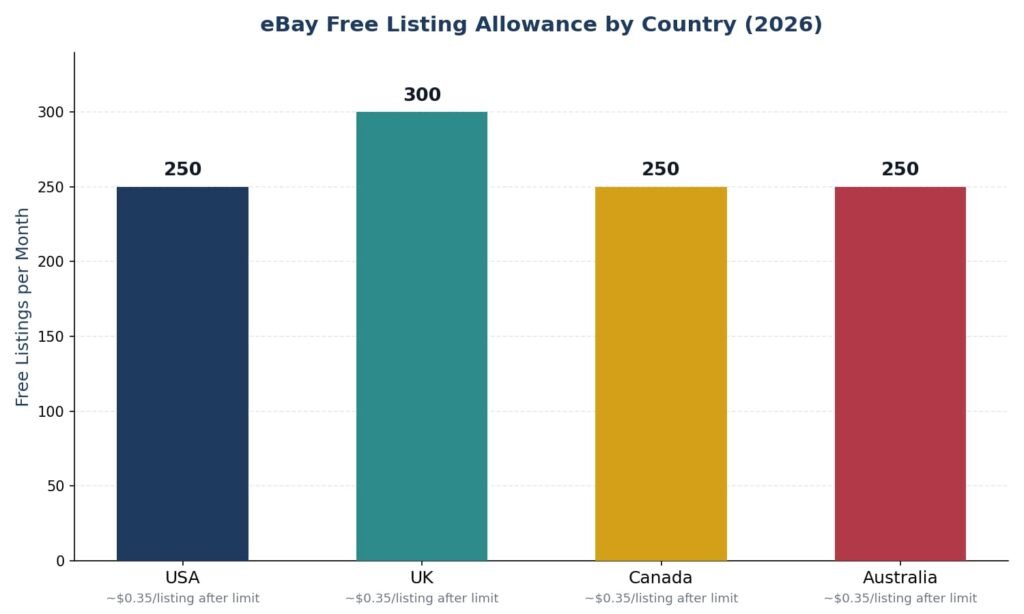
Category exclusions may apply
Rates are approximate and can vary by category — always confirm current figures on eBay’s official Seller Fees page or with our eBay Fee Calculator.
Not sure how much you’ll actually pay? Use our free eBay Fee Calculator to estimate your insertion fees, final value fees, and net profit for the US, UK, Canada, and Australia.
How to Avoid eBay Listing Fees
You can’t negotiate the insertion fee once it applies, but you can structure your selling to avoid it almost entirely:
Stay within your monthly free allowance — track how many active listings and relists you’ve used this month
List in a single category where possible, since listing in two categories doubles the insertion charge on that item
Avoid unnecessary relisting — every relist of an unsold item consumes a free slot or triggers a new fee
Watch for eBay’s free listing promotions — eBay periodically runs “free listing” events that temporarily lift category restrictions or raise allowances
Consider a Store subscription once you’re consistently exceeding 250 (US/Canada/Australia) or 300 (UK) listings a month — the monthly subscription cost is often cheaper than paying per-listing insertion fees at volume
Beyond these tactical steps, it’s worth building a simple monthly habit: before your billing cycle resets, check your Seller Hub’s active listing count against your free allowance. If you’re consistently landing within 20-30 listings of your limit, that’s a signal to either slow your relisting cadence slightly or start seriously comparing the numbers on a Store subscription — the math tends to favor upgrading well before most sellers expect it to, especially once the final value fee discount that comes bundled with most Store tiers is factored into the comparison.
eBay Listing Fees vs Final Value Fees
This is one of the most common points of confusion for new sellers, so it’s worth stating plainly:
Listing Fee (Insertion Fee)
Final Value Fee
When charged
At the moment of listing
Only after the item sells
Refundable if unsold?
No
N/A — not charged if unsold
Typical cost
$0 (within free allowance) or $0.35/listing
~13.6% of total sale (US, most categories)
Biggest cost driver for most sellers
Rarely — most stay within free allowance
Yes — this is the main cost on eBay
For a full breakdown of the final value fee and how it’s calculated across the US, UK, Canada, and Australia, see our complete guide: eBay Selling Fees (2026): Complete Guide for UK & US Sellers.
Understanding this distinction changes how you should think about pricing. Because the insertion fee is a fixed, predictable cost (usually zero) while the final value fee scales with your sale price, the final value fee is almost always the number that should drive your pricing decisions — not the listing fee. A seller worried about “eBay fees” eating into margin should spend their planning time on category selection, Store discounts, and Top Rated Seller status (all of which affect the final value fee), rather than on listing fee avoidance alone, which only matters at higher volumes.
Frequently Asked Questions
The questions below cover the specific details sellers ask most often about eBay listing fees — from basic definitions through country-specific allowances — pulled directly from real seller questions and search patterns.
What are eBay listing fees?
eBay listing fees, officially called insertion fees, are charges eBay applies for creating a listing — separate from the final value fee, which only applies once an item sells.
How much does eBay charge to list an item?
For most non-Store sellers, listing is free up to 250 items per month in the US, Canada, and Australia, or 300 in the UK. Beyond that, eBay charges $0.35 per listing (or local currency equivalent) in most categories.
Do you pay listing fees on eBay?
Only if you exceed your monthly free listing allowance. Most casual and part-time sellers never pay an insertion fee at all.
How many free listings does eBay give?
250 per month for non-Store sellers in the US, Canada, and Australia; 300 per month in the UK. Store subscribers get significantly more.
What is an eBay insertion fee?
It’s the official name for eBay’s listing fee — a charge applied per listing (and per category) once you exceed your free monthly allowance, whether or not the item sells.
Are eBay listing fees different in the UK and USA?
Slightly — the UK offers 300 free listings per month versus 250 in the US. The insertion fee structure beyond that allowance works similarly in both marketplaces.
What are eBay listing fees in Canada?
eBay Canada mirrors the US structure — 250 free listings per month, then a per-listing insertion fee (charged in CAD) beyond that.
What are eBay listing fees in Australia?
eBay Australia also provides 250 free listings per month, with a per-listing insertion fee in AUD once you exceed it, subject to category exclusions.
How many free listings do UK sellers get?
UK sellers get 300 free listings per month — the highest free allowance among the four markets covered in this guide.
Conclusion
Understanding eBay listing fees helps you avoid unnecessary costs and price your products more accurately. Most casual sellers never pay insertion fees because they stay within the monthly free listing allowance, while high-volume sellers can often reduce costs with an eBay Store subscription. The key distinction to remember is that listing fees apply the moment you create a listing (if at all), while the final value fee — the much bigger cost for most sellers — only applies once an item actually sells.
Before listing your next item, use our free eBay Fee Calculator to estimate your total fees and expected profit across the US, UK, Canada, and Australia.
Fact-checked
Last updated: August 2026
Reviewed against: Official eBay Seller Fee schedules (US, UK, Canada & Australia)
Calculate Your Exact eBay Fees
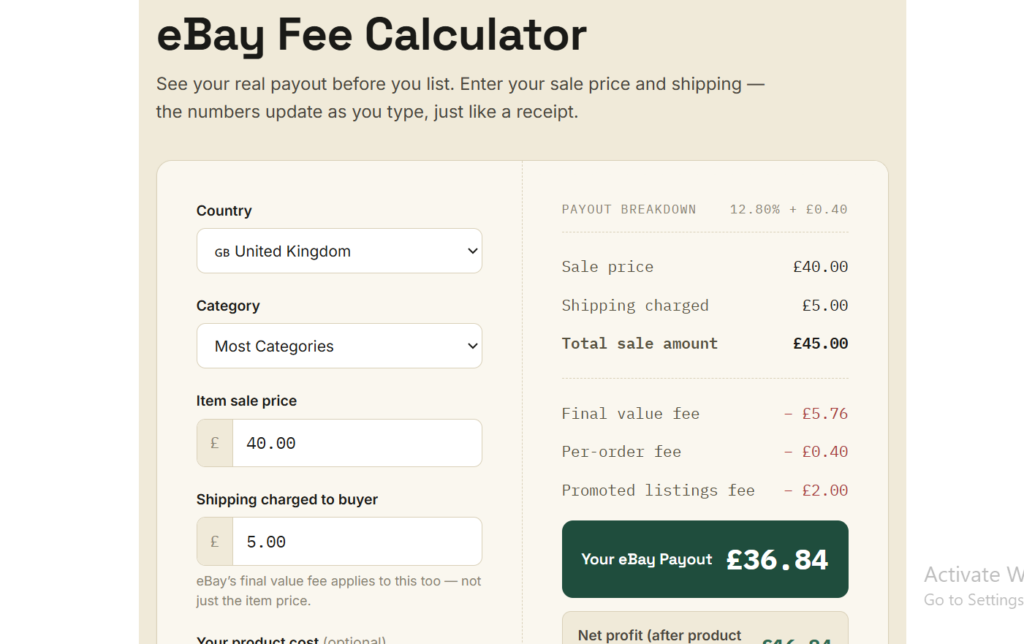
Listing fees are only half the picture — the final value fee is what really affects your margin once an item sells. Use our free eBay Fee Calculator to see your full cost breakdown — insertion fee, final value fee, and net payout — for US, UK, Canada, and Australia listings
Related Articles
eBay Selling Fees (2026): Complete Guide for UK & US Sellers
eBay Fees Explained (2026): Complete Guide to Final Value Fees, Listing Fees & Seller Costs
eBay Store Fees Explained (coming soon)
eBay Final Value Fee Guide (coming soon)
eBay Insertion Fees: Deep Dive (coming soon)
eBay Fee Calculator
A note on accuracy: eBay’s free listing allowances and insertion fee amounts can change without much notice, and can vary further by category. The figures in this guide reflect eBay’s published US, UK, Canada, and Australia seller fee schedules as of 2026. Because rates shift, we recommend verifying your specific category rate on eBay’s official Seller Fees page or using our calculator above, which we update as new rate changes are confirmed.