eBay promoted listings fees can quietly become one of your biggest costs — or a smart investment that pays for itself many times over. It depends entirely on whether you understand how the ad rate actually works, and on a major change that rolled out across every English-speaking eBay marketplace in early 2026: eBay now charges ad fees on far more sales than it used to, because of a new 30-day attribution rule. If you turned on Promoted Listings a while back and haven’t revisited the math since, this guide is worth reading closely.
We’ll cover eBay promoted listings fees across the US, UK, Canada, and Australia — Standard versus Advanced, how the new attribution model changes your real cost, a full worked ROI example, and how to set an ad rate that protects your margin instead of quietly eating it. Want to see your total fees including advertising? Our free eBay Fee Calculator covers all four countries.
Key Takeaways
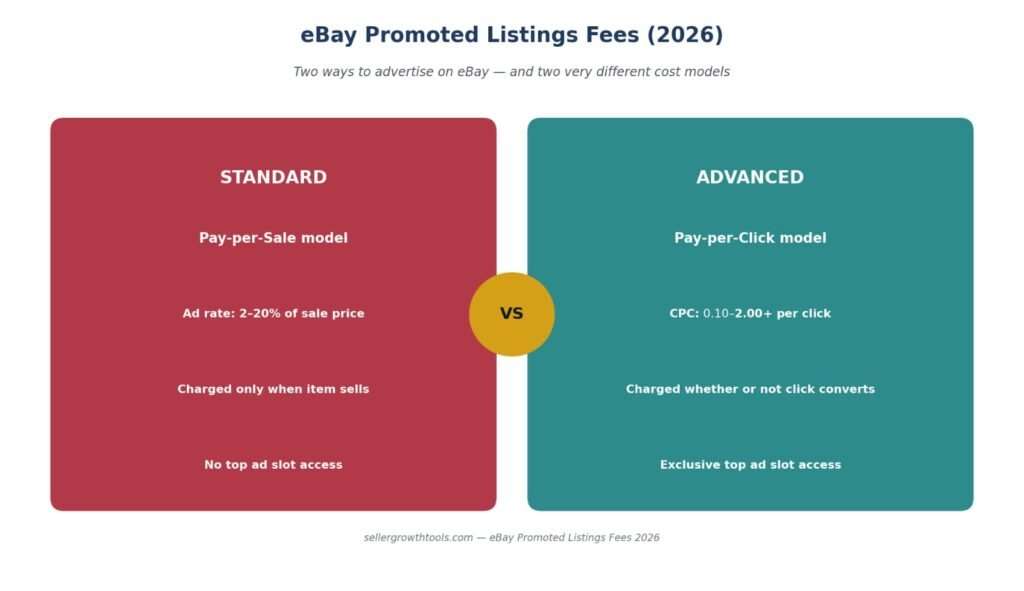
Standard = Pay per Sale (2-20% ad rate, charged only when the item sells)
Advanced = Pay per Click ($0.10-$2+ per click, charged regardless of sale)
The 2026 Attribution Rule changed how many sales your ad fee actually applies to
Always calculate ROI before increasing your ad rate
Use our eBay Fee Calculator before launching any campaign
Table of Contents
What Are eBay Promoted Listings Fees?
How eBay Promoted Listings Fees Work
Standard vs Advanced Promoted Listings
The 2026 Attribution Change (Read This First)
eBay Promoted Listings Fees USA
eBay Promoted Listings Fees UK
eBay Promoted Listings Fees Canada
eBay Promoted Listings Fees Australia
Promoted Listings Fees: Worked Examples
Is eBay Promoted Listings Worth It?
How to Set an Effective Ad Rate
Frequently Asked Questions
What Are eBay Promoted Listings Fees?
eBay promoted listings fees are the advertising costs you pay to boost a listing’s visibility in search results and category browsing — separate from, and on top of, the listing fee and final value fee we’ve covered in our other guides. Unlike those fees, Promoted Listings is entirely optional and entirely within your control: you decide whether to advertise, which items to promote, and how much to spend.
With roughly 136 million active buyers browsing eBay worldwide and over 2.5 billion live listings competing for their attention, standing out in search results has become harder purely on organic ranking alone — which is exactly the gap Promoted Listings is designed to fill, for a price.
There are two fundamentally different pricing models depending on which campaign type you choose. Standard (sometimes called “General”) campaigns charge you a percentage of the sale price, but only when the promoted item actually sells. Advanced (sometimes called “Priority”) campaigns charge you per click, whether or not that click turns into a sale. That distinction — pay-per-sale versus pay-per-click — is the single most important thing to understand before you touch the ad rate slide.
How eBay Promoted Listings Fees Work?
Standard Campaigns (Pay-Per-Sale)
With Standard, you set your own ad rate — a percentage, typically somewhere between 2% and 20% of the sale price — and eBay only charges that fee if the listing sells while your ad is active. There’s no cost for impressions or clicks that don’t convert, which makes Standard the lower-risk option most individual sellers start with.
Advanced Campaigns (Pay-Per-Click)
Advanced works more like traditional pay-per-click advertising: you bid on keywords, set a daily budget, and pay every time someone clicks your ad — whether they buy or not. Typical costs run $0.10 to $2.00+ per click depending on how competitive your keywords are, with a minimum daily budget of around $1. Since January 2026, Advanced campaigns also get exclusive access to the very top ad slot in search results — a position Standard campaigns can no longer reach at all.
Standard vs Advanced Promoted Listings
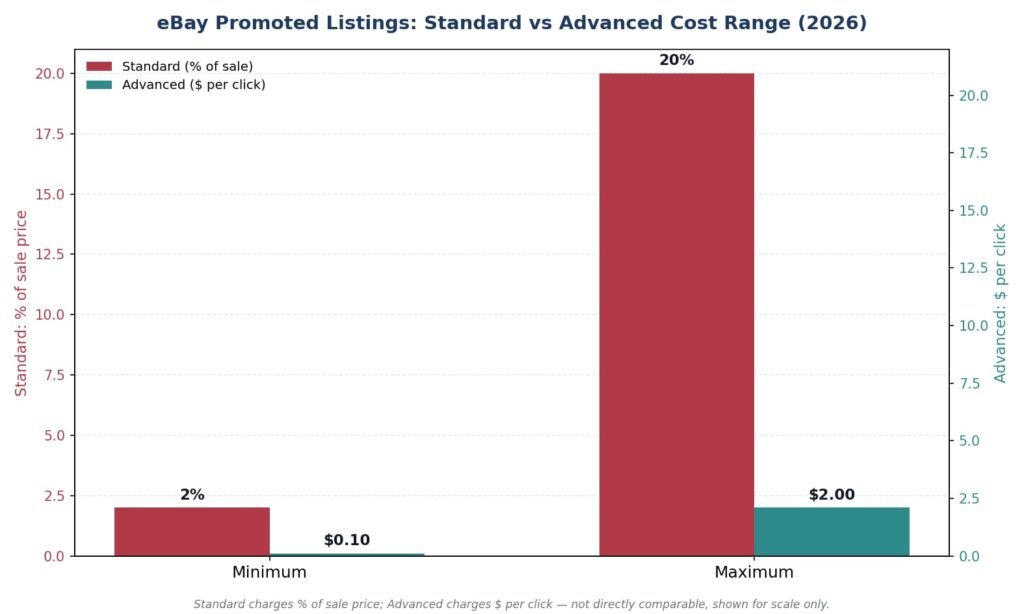
| Campaign | Payment Model | Typical Cost | Best For |
|---|---|---|---|
| Standard | Pay per Sale | 2–20% | Most Sellers |
| Advanced | Pay per Click | $0.10–$2+ CPC | High Competition |
For a fuller breakdown of the mechanics behind each model:
| Standard | Advanced | |
|---|---|---|
| You pay when | Item sells | Someone clicks (sale or no sale) |
| Top ad slot access | No (as of 2026) | Yes |
| Risk level | Lower | Higher — requires active management |
The 2026 Attribution Change (Read This First)
This is the part of eBay promoted listings fees that catches even experienced sellers off guard in 2026, so it’s worth its own section before we get into country breakdowns.
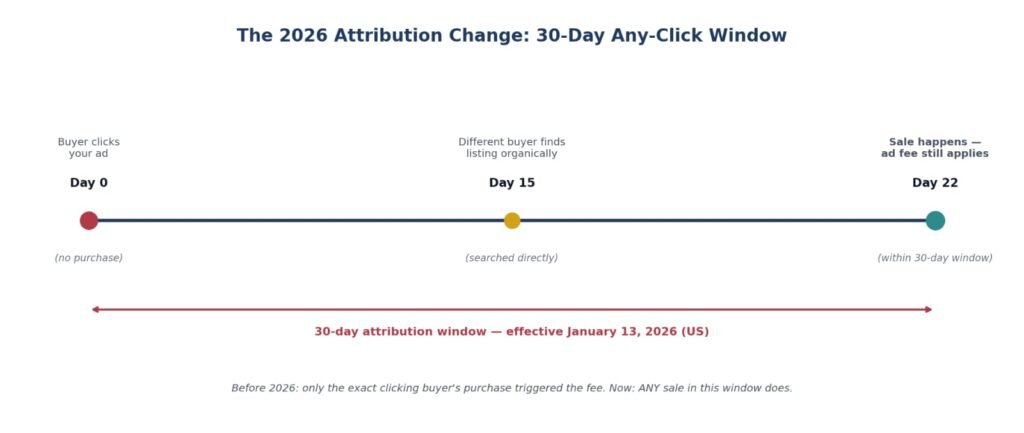
Starting January 13, 2026 in the US (and earlier in 2025 for the UK, Germany, Australia, France, Italy, and Spain), eBay changed how it decides which sales count as “ad sales” for Standard campaigns. Under the old model, you only paid the ad fee if the exact buyer who clicked your ad was the one who purchased. Under the new model, a single click starts a 30-day attribution window — and any sale of that item within those 30 days triggers the ad fee, even if the eventual buyer never saw or clicked your ad at all.
The practical impact has been significant. UK and German sellers who switched to this model earlier saw their effective ad-attributed sale percentage jump from roughly 35% to over 80%. That means if you were previously paying your ad rate on about a third of your sales, you may now be paying it on the large majority of them — even though the ad rate percentage itself hasn’t changed. Your headline rate stays the same; your actual advertising cost as a share of total revenue can more than double.
This effect compounds badly for multi-quantity listings. One curious click on an item you have 200 units of can trigger the attribution window across every sale of that item for the next 30 days — meaning a single “window shopper” click can end up costing you ad fees on dozens of unrelated sales.
eBay Promoted Listings Fees USA
US sellers set Standard ad rates anywhere from 2% to 20%, with many sellers defaulting to eBay’s suggested 12-15% without questioning whether that’s actually the right number for their margins — which, as covered above, is now a riskier default than it used to be under the 30-day attribution model. Advanced campaigns run the same $0.10-$2.00+ per-click range as described earlier, with the top search ad slot now exclusive to Advanced/Priority campaigns.
eBay Promoted Listings Fees UK
UK sellers operate under the same Standard/Advanced structure, with ad rates and CPC ranges quoted in GBP rather than USD. The UK was among the first marketplaces to move to the 30-day attribution model — UK sellers saw their attribution rates jump from around 35% to over 80% well before US sellers experienced the same shift, so UK seller communities have more real-world data on the actual cost impact than most other markets. If you’re a UK seller who hasn’t revisited your ad rate since before this change rolled out, it’s worth doing so now rather than assuming your old numbers still hold.
eBay Promoted Listings Fees Canada
Canadian sellers use the same Standard and Advanced structure, priced in CAD, with the same percentage-based and per-click ranges applying. The 30-day attribution model has also rolled out to the Canadian marketplace as part of eBay’s broader global rollout, so the same attribution-rate caution applies here as in the US and UK.
eBay Promoted Listings Fees Australia
Australia was one of the earlier markets to receive the 30-day attribution change alongside the UK, meaning Australian sellers have had more time to adjust their ad rate strategy around the new model than their US counterparts. The underlying Standard/Advanced mechanics are identical to the other three markets, priced in AUD.
Promoted Listings Fees: Worked Examples
Example 1 — Standard Campaign, Old vs New Attribution
A seller runs a Standard campaign at a 10% ad rate on an item selling for $50, moving 20 units a month.
Old attribution model (roughly 35% of sales ad-attributed): 7 sales trigger the ad fee → 7 × $5.00 = $35/month in ad fees
New 2026 attribution model (roughly 80% of sales ad-attributed): 16 sales trigger the ad fee → 16 × $5.00 = $80/month in ad fees
Same 10% ad rate, same sales volume — more than double the actual advertising cost, purely because of the attribution change.
Example 2 — Advanced Campaign ROI
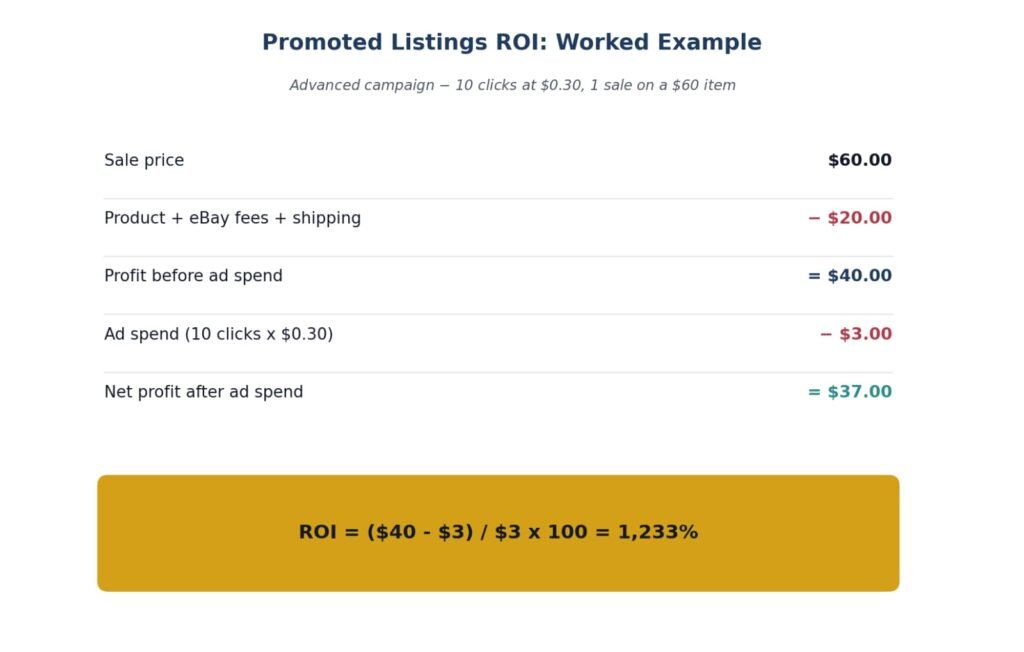
A seller runs an Advanced campaign getting 10 clicks at $0.30 each ($3.00 total ad spend) and lands 1 sale on a $60 item with $20 total costs (product + eBay fees + shipping).
Profit before ad spend: $60 – $20 = $40
Ad spend: $3.00
Net profit after ad spend: $37
ROI: ($40 – $3) / $3 × 100 = 1,233%
This example shows why Advanced can be highly profitable when it converts — but the same math flips badly if those 10 clicks produce zero sales, since the $3.00 is spent either way
Is eBay Promoted Listings Worth It?
Is eBay Promoted Listings worth it comes down to whether the extra visibility converts into sales you wouldn’t have made organically, at a cost your margin can absorb. A few practical signals:
Slow-moving inventory with decent margin: Standard at a modest 2-4% ad rate is often worth testing — the cost-per-sale model limits your downside.
Highly competitive categories (electronics, sneakers, trading cards, branded apparel): Advanced’s access to the top ad slot can matter more here than Standard’s lower risk, since Standard can no longer reach that position at all.
Thin-margin items: Be cautious. Under the 2026 attribution model, a 10% ad rate can now apply to the large majority of your sales rather than a third of them — run the numbers before assuming the old rate still makes sense.
High-volume, multi-quantity listings: Be especially careful with Standard here, since one click can trigger the 30-day window across every subsequent sale of that item.
Who Should Use eBay Promoted Listings?
Some seller types tend to get more consistent value from Promoted Listings than others:
New sellers — building initial visibility and sales history before organic ranking kicks in
High-volume sellers — where even a small conversion lift compounds across many listings
Seasonal sellers — pushing visibility during short, high-demand windows
Sellers in competitive categories — where organic search alone struggles to surface a listing
Branded product sellers — where buyer intent is already high and ads mainly capture demand that already exists
How to Set an Effective Ad Rate
Setting an ad rate that protects your margin — rather than accepting eBay’s suggested default — is the single highest-leverage thing you can do with Promoted Listings in 2026:
Calculate your maximum sustainable ad rate before launching, based on your actual margin after product cost, final value fee, and shipping — not before it.
Start lower than you think you need to. A 3-5% Standard rate is a reasonable starting point for testing; you can raise it if visibility genuinely isn’t improving.
Re-run your math now if you set your rate before 2026. The attribution change alone may mean your old “safe” rate no longer is.
Watch multi-quantity listings closely given the 30-day attribution window’s compounding effect on repeat sales of the same item.
Reserve Advanced for items where the top ad slot genuinely changes outcomes — not as a default across your whole catalog, given its pay-regardless-of-sale structure.
Run your numbers through the eBay Fee Calculator alongside your final value fee and listing costs to see your true all-in cost per sale, not just the ad rate in isolation.
Common Promoted Listings Mistakes
Even experienced sellers fall into a handful of predictable traps with Promoted Listings. Watching for these can save real money:
Using eBay’s suggested ad rate blindly — the default isn’t calculated against your specific margin, and accepting it without checking your own numbers is one of the fastest ways to advertise at a loss.
Promoting low-margin products — items with thin margins have little room left after an ad fee is applied, especially under the current attribution model.
Running Advanced without testing first — jumping straight into cost-per-click bidding without a small test budget can burn through spend before you know if it converts.
Not calculating ROI before or during a campaign — visibility isn’t the same as profit; a campaign generating clicks and impressions can still be losing money.
Forgetting about the 30-day attribution window — assuming your ad fee only applies to sales directly traceable to a click, when in 2026 it applies far more broadly than that.
How Much Does It Cost to Advertise on eBay?
Promoted Listings don’t have a fixed price. You set your own ad rate — a percentage of the final sale price — and it’s only charged when an ad directly drives a sale.
The range most sellers use is 2–15%. eBay suggests a “trending rate” for each category — the rate at which similar listings are currently being promoted. Going below the trending rate usually means less visibility; going above it can improve placement but eats into margin.
What you actually pay
Ad rate × sale price = Promoted Listings fee
On a £40 sale with a 5% ad rate: £2.00 in Promoted Listings fees, on top of your final value fee.
That fee stacks on top of everything else. A 5% ad rate on top of a 13.6% final value fee means eBay takes nearly a fifth of your sale. Price that in before you turn promotion on.
When the fee is charged
Only when a buyer clicks your promoted listing and purchases within 30 days. If they find your listing organically — through regular search — no Promoted Listings fee applies, even if you have the listing promoted.
Is there a minimum or maximum?
The minimum ad rate is 2%. There’s no hard ceiling, but going above 20% is rarely worthwhile — you’re giving away margin without a proportionate gain in visibility.
Frequently Asked Questions
What are eBay Promoted Listings?
An optional advertising feature that boosts a listing’s visibility in search and browse results, in exchange for either a percentage-of-sale fee (Standard) or a cost-per-click fee (Advanced).
How much does eBay charge for Promoted Listings?
Standard ad rates typically run 2-20% of the sale price, set by the seller. Advanced runs $0.10-$2.00+ per click depending on keyword competition, with a minimum daily budget around $1.
Are eBay Promoted Listings worth it?
It depends on your margin and category competitiveness. Standard at a low-to-moderate rate is often worth testing on slow-moving, decent-margin inventory. Always calculate your maximum sustainable rate before enabling it, especially under the 2026 attribution model.
What is the best ad rate on eBay?
There’s no universal number — it depends on your margin after all other fees. Many experienced resellers start around 2-4% for Standard campaigns and adjust based on actual results rather than accepting eBay’s suggested default.
Do Promoted Listings increase sales?
Many sellers report meaningfully more views and impressions with Promoted Listings active, though actual sales impact varies by category, competition, and how well-optimized the listing itself is.
Standard vs Advanced Promoted Listings — what’s the difference?
Standard charges a percentage of the sale price and only when the item sells. Advanced charges per click regardless of outcome, but gets exclusive access to the top search ad slot as of 2026.
How are Promoted Listings fees calculated?
For Standard, it’s your set ad rate multiplied by the sale price, charged only on ad-attributed sales — which, since January 2026, includes any sale within 30 days of a click on your ad. For Advanced, it’s the cost per click multiplied by total clicks, regardless of whether they convert.
Can I change my ad rate anytime?
Yes, ad rates on Standard campaigns can be adjusted at any time through Seller Hub, and changes typically apply to future performance rather than retroactively.
How did the 2026 attribution change affect Promoted Listings fees?
It expanded which sales count as ad-attributed, from a same-buyer-click model to a 30-day any-click window. UK and German sellers who experienced this change earlier saw attribution rates roughly double, meaning the same ad rate now applies to significantly more sales.
Can Promoted Listings hurt profit?
Yes, if the ad rate isn’t calculated against your actual margin. On thin-margin items especially, an ad fee applied under the 2026 attribution model can turn what looked like a profitable sale into a loss.
Should beginners use Promoted Listings?
Beginners can benefit from Standard campaigns at a low, conservative ad rate to build initial visibility, but should calculate their break-even rate first rather than accepting eBay’s suggested default, and generally avoid Advanced campaigns until they’re comfortable managing bids and budgets.
Fact-checked
Last updated: August 2026
Reviewed against: Official eBay Promoted Listings documentation and Seller Hub Ads guidance (US, UK, Canada & Australia)
Conclusion
eBay Promoted Listings fees only work in your favor if you calculate them the same way you’d calculate any other advertising spend — against your actual margin, not against eBay’s suggested default. The 2026 shift to 30-day any-click attribution has quietly raised the real cost of Standard campaigns for many sellers, even where the ad rate itself hasn’t moved. Before turning on Promoted Listings, or leaving an old campaign running unchanged, run your numbers through our free eBay Fee Calculator to see your true all-in cost per sale across final value fees, listing fees, and advertising combined.
Calculate Your Exact eBay Fees
Advertising costs are only one piece of what eBay actually takes from a sale. Use our free eBay Fee Calculator to see your complete cost breakdown — final value fee, listing fee, and net payout — for US, UK, Canada, and Australia listings.
Related Articles
Related Guides
Ad spend sits on top of everything else. This covers the fees underneath it.
Enter your ad rate alongside the sale price and see the real payout.
Fix the listing first — paying to promote a weak listing wastes money.
Work out whether the extra sales justify the ad rate you’re paying.
When promoting is worth it, and when competition makes it expensive.
A note on accuracy: eBay’s Promoted Listings ad rates, attribution rules, and campaign structures have changed significantly and recently — the 30-day attribution model described here rolled out across major English-speaking marketplaces through 2025 and January 2026. The figures in this guide reflect eBay’s published documentation as of 2026. Given how recently this changed, we recommend verifying current terms in your own Seller Hub before setting or adjusting an ad rate, and using our calculator above, which we update as new changes are confirmed.
Muhammad Usman
eCommerce & SEO Specialist
Muhammad works with eBay and marketplace sellers across the UK and US, handling listings, fee structures and store optimisation day to day. He writes these guides because most eBay advice online explains the rule without explaining what to actually do about it.
Every guide here is checked against eBay’s current documentation before publishing and revisited when policies change. More about this site · Get in touch