Quick Answer: eBay shipping costs depend on who pays — the buyer or the seller — and which carrier and service level you choose. Whatever you charge the buyer for shipping counts as part of your total sale price, which means eBay’s Final Value Fee applies to it too. Buying labels directly through eBay usually gets you discounted carrier rates, and shipping cost is one of the biggest levers sellers have for improving profit margin.
Key Takeaways
Shipping charged to the buyer counts as revenue — eBay charges fees on it, not just the item price
eBay-purchased shipping labels typically get discounted carrier rates vs buying separately
Free shipping can boost visibility in search results, but the cost still has to come from somewhere in your pricing
International shipping costs and customs rules add real complexity — plan for them upfront
Small packaging and shipping choices compound into meaningful profit differences at volume.
Table of Contents
What Are eBay Shipping Costs?
How eBay Shipping Works
Buyer-Paid vs Seller-Paid Shipping
eBay Shipping Labels
Best Shipping Carriers for eBay Sellers
Shipping Option Comparison
Domestic vs International Shipping
eBay International Shipping Program (eIS)
Packaging Best Practices
How to Reduce Shipping Costs
Common Shipping Mistakes
Frequently Asked Questions
Related Guides
Shipping is one of the most overlooked profit-killers on eBay. Sellers obsess over the Final Value Fee percentage, but shipping cost — packaging, carrier rates, label pricing, international surcharges — often swings a listing from profitable to break-even far more than the fee itself does.
This guide breaks down exactly how eBay shipping costs work, who pays what, how labels are priced, and where sellers most commonly lose money without realizing it.
What Are eBay Shipping Costs?
eBay shipping costs cover everything involved in getting an item from seller to buyer: the carrier rate itself, packaging materials, any insurance or tracking add-ons, and — for international orders — customs and duties handling. Some of this cost is charged to the buyer at checkout, some is absorbed by the seller, and how you split it directly affects both your competitiveness and your margin.
To see exactly how shipping charged to the buyer affects your bottom line alongside eBay’s fees, run the numbers through our eBay ROI Calculator — it factors in shipping charged to the buyer as part of revenue, exactly as eBay does when calculating fees.
How eBay Shipping Works
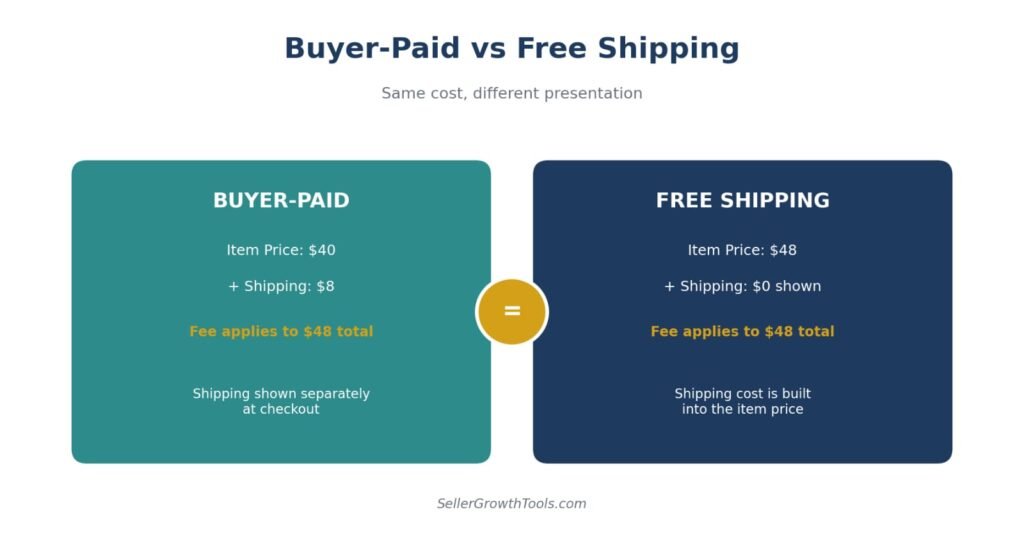
When you create a listing, you set a shipping option: a flat rate you charge the buyer, free shipping (built into your item price), or calculated shipping based on the buyer’s location. Whatever the buyer pays for shipping is added to the item price to form the total sale amount — and that total is what eBay’s Final Value Fee is calculated against, not just the item price alone. For the exact percentage that applies to your category, see our eBay Final Value Fee guide.
Buyer-Paid vs Seller-Paid Shipping
| Approach | How It Works | Effect on Fees |
|---|---|---|
| Buyer-Paid Shipping | Buyer pays a separate shipping charge at checkout | Fee applies to item price + shipping charged |
| Free Shipping | Shipping cost is built into the item price | Fee applies to the full item price (which already includes shipping cost) |
Free shipping is often favored by eBay’s search algorithm and by buyers who dislike surprise costs at checkout — but “free” doesn’t mean the cost disappears, it just gets folded into your item price. Either way, run both scenarios through our eBay Fee Calculator before deciding which approach nets you more profit on a given item.
eBay Shipping Labels
Buying your shipping label directly through eBay (rather than at a post office or third-party site) typically unlocks discounted carrier rates, since eBay negotiates bulk pricing with major carriers. Labels are generated straight from your order in Seller Hub, and the cost is deducted from your Managed Payments balance rather than charged separately — see our eBay Managed Payments guide for how that deduction shows up in your payout.
Sellers running a Store subscription often get additional shipping discounts or supplies as part of their plan — worth checking against our eBay Store Fees breakdown if you’re weighing whether a Store tier pays for itself.
Best Shipping Carriers for eBay Sellers
USPS (US)
The most commonly used carrier for domestic US sellers, with eBay-discounted rates available directly through Seller Hub for most package sizes and weights.
Royal Mail (UK)
The standard carrier for UK sellers, offering tracked and untracked options with eBay label discounts on most services.
Canada Post
Canada’s primary carrier for eBay sellers, with domestic and international shipping options available through eBay’s label purchase flow.
Australia Post
The go-to carrier for Australian sellers, covering both domestic parcels and international shipments with eBay-integrated label pricing.
Shipping Option Comparison
| Shipping Option | Best For | Pros | Cons |
|---|---|---|---|
| Free Shipping | Lightweight items | Higher conversion | Lower margin |
| Flat Rate | Standard products | Easy pricing | May over/undercharge |
| Calculated Shipping | Heavy items | Accurate charges | Slightly more complex |
Domestic vs International Shipping
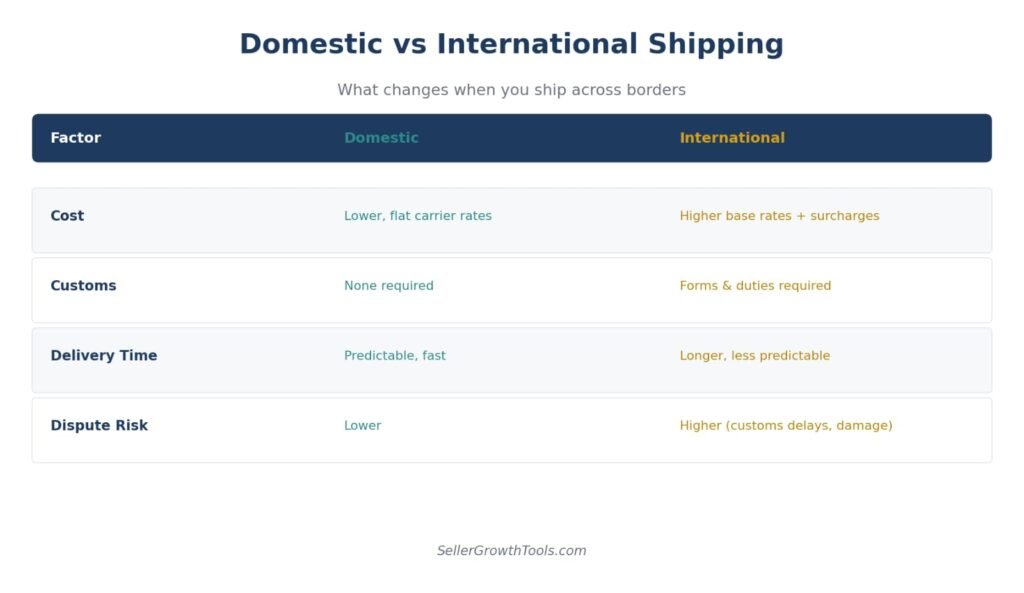
Domestic shipping is generally straightforward — flat carrier rates, predictable delivery windows, no customs involved. International shipping adds real complexity: customs forms, import duties (often the buyer’s responsibility, but disputes still land on the seller), longer and less predictable delivery times, and higher base carrier rates.
If you’re expanding beyond your home marketplace, model your numbers separately for each destination country rather than assuming domestic margins will hold — a listing that’s profitable shipping within the US can look very different once you’re shipping into the UK, Canada, or Australia.
eBay International Shipping Program (eIS)
What Is eIS?
eBay’s International Shipping Program lets sellers ship domestically to an eBay-operated hub, which then handles international forwarding, customs paperwork, and delivery to the buyer — without the seller dealing with customs forms directly.
Benefits for Sellers
No customs forms to fill out yourself — eBay’s hub handles international paperwork
Domestic-only shipping from your side, even though the buyer is overseas
Access to international buyers without learning each destination country’s import rules individually.
When Should You Use It?
eIS makes the most sense if you’re new to international selling, ship low-to-medium value items, or want to test international demand without building out customs expertise first. Higher-volume international sellers sometimes graduate to shipping directly once they’re comfortable with the process.
Shipping Insurance
When should you buy insurance? Consider it for any item where the cost of loss or damage would meaningfully hurt your margin — insurance cost is usually small relative to the protection it gives on a higher-value sale.
Benefit for high-value items: For anything where a single lost or damaged package would wipe out several sales’ worth of profit, insurance is generally worth the extra cost.
When is signature confirmation necessary? Use it for high-value items and for orders where a “package not received” dispute would be costly to resolve — it gives you delivery proof that protects against both lost-package claims and payment disputes.
Packaging Best Practices
Use the correct box size — oversized boxes trigger dimensional weight charges and waste padding
Protect fragile items properly — the cost of proper padding is far cheaper than a damage claim
Measure dimensions accurately before buying a label, since carriers charge based on actual size and weight
Keep package weight low with lightweight packaging materials wherever the item allows it.
Warning Box
Shipping charged to the buyer is still included in the total amount on which eBay calculates the Final Value Fee. Always include this in your profit calculations.
How to Reduce Shipping Costs
Buy labels through eBay to access discounted carrier rates
Use lightweight, appropriately-sized packaging to avoid dimensional weight surcharges
Compare carrier options rather than defaulting to the same one for every listing
Bundle multiple items into a single shipment where buyers purchase more than one item
Reconsider free shipping vs buyer-paid shipping on heavier or bulkier items, where the cost difference is largest.
Common Shipping Mistakes
Pricing an item without first checking the actual shipping cost to ship it
Using oversized boxes that trigger dimensional weight charges
Forgetting that shipping charged to the buyer is still subject to eBay’s Final Value Fee
Ignoring international shipping cost differences when expanding to new marketplaces
Not accounting for packaging materials (boxes, tape, labels) as a real cost, not an afterthought.
Frequently Asked Questions
How much does eBay shipping cost?
It depends entirely on the item’s weight, dimensions, destination, and carrier — there’s no single flat number. Buying your label through eBay’s discounted rates is usually the cheapest option compared to third-party shipping.
Does eBay charge fees on shipping I charge the buyer?
Yes. Any shipping amount you charge the buyer is added to the item price to form the total sale amount, and eBay’s Final Value Fee applies to that total — not just the item price.
Is free shipping actually free?
No — the cost is simply built into your item price instead of shown separately. It can help with search visibility, but you still need to account for it in your pricing.
Are eBay shipping labels cheaper than the post office?
Often yes, since eBay negotiates discounted bulk rates with major carriers that individual sellers typically can’t access on their own.
How do I calculate shipping cost before listing an item?
Weigh and measure the item, check the carrier’s rate for that weight/destination, then add your packaging cost. Our eBay Fee Calculator and eBay ROI Calculator both let you enter shipping cost directly so you can see the full profit picture before you list.
Does international shipping affect my selling limits?
Not directly, but international orders can affect processing time and dispute rates, which indirectly ties into account performance — see our eBay Selling Limits guide for how limits are actually calculated.
Related Guides
Postage is charged a final value fee too — this works out the real cost.
Why free postage isn’t free, and how it’s treated in the fee calculation.
Late dispatch and missing tracking are defects — cheap postage can cost your status.
Who pays return postage, and when you’re obliged to cover it.
Postage is the expense most sellers forget when working out margin.
CTA
Not sure how shipping affects your profit? Use our eBay Fee Calculator and eBay ROI Calculator to calculate your exact fees, shipping costs, and expected profit before listing an item.
See Your Real Profit After Shipping & Fees
Plug your shipping cost into our free calculators before you price your next listing.
eBay Fee Calculator eBay ROI CalculatorConclusion
Shipping cost is where a lot of eBay sellers quietly lose margin — not because they ignore it entirely, but because they price first and check shipping cost second. Whether you charge the buyer separately or fold it into “free” shipping, the cost is real, it’s subject to eBay’s fees just like the item price is, and it deserves the same attention as any other line in your profit calculation.
Author Box
Written by Muhammad Usman
eCommerce & SEO Specialist with 5+ years of experience in eBay, Amazon, Etsy and TikTok Shop. This guide is based on official eBay documentation and practical seller experience.
Fact-Checked Box
This guide has been reviewed against official eBay Seller documentation and updated for 2026. Shipping rates, label discounts and carrier options may vary by marketplace and account.