The eBay vs Amazon debate is one of the most common decisions new sellers face — and one of the most frequently revisited by experienced ones. Both marketplaces attract millions of buyers every month, but they operate very differently and reward different types of sellers.
This guide compares eBay and Amazon across the factors that matter most: selling fees, profit margins, fulfillment options, competition and buyer reach. It also covers what US and UK sellers need to know specifically, and provides a straightforward recommendation based on your products and goals.
eBay vs Amazon: Quick Comparison
| Feature | eBay | Amazon |
|---|---|---|
| Listing Format | Auction or fixed price — your own listing | Fixed price on a shared product catalog page |
| Selling Fees | ~13.25% final value fee (most categories) | ~15% referral fee + FBA or shipping costs |
| Fulfillment Options | Seller ships directly to buyer | FBA (Amazon ships) or FBM (seller ships) |
| Used / Second-Hand Items | Very well supported — large buyer audience | Limited to specific categories |
| Private Label / Brand | Possible but less structured | Well established — Amazon Brand Registry available |
| Seller Control | High — own listings, pricing and shipping | Lower — Amazon sets many policies and controls buy box |
| Monthly Fee Required | No (optional Store subscription) | Individual plan: none ($0.99/item) — Professional plan: $39.99/month (US); required for FBA |
| Best For | Used items, collectibles, unique products, resellers | New branded products, high-volume sellers, private label |
Which Is Better for Beginners?
For most new sellers, eBay is the easier marketplace to start on.
You do not need a monthly subscription to begin — you can list up to 250 items per month for free using eBay’s zero insertion fee allowance. There is no requirement to hold inventory in a warehouse, no upfront storage fees, and no gating process for most product categories. If you have items at home you want to sell, or you are testing product ideas before committing to larger inventory, eBay lets you do that with very little risk.
Amazon requires a $39.99 per month Professional seller account to access the full range of selling tools, including the ability to list new products or use FBA. There is an Individual plan that avoids the monthly fee, but it charges $0.99 per item sold and limits what you can do. Amazon also restricts certain categories and requires approval to sell branded products in some cases, which can slow down new sellers.
The learning curve also differs. eBay listings are largely under your control — you write the title, description and terms yourself. Amazon listings are tied to existing product catalog pages, which means you compete for the same listing rather than creating your own. For a beginner unfamiliar with keyword optimization and competitive pricing, this can be disorienting.
That said, Amazon becomes more compelling once you have a scalable product, because FBA allows you to ship inventory to Amazon’s fulfillment centers and let them handle storage, packing and delivery. This removes a significant operational burden for sellers moving larger volumes.
eBay vs Amazon Selling Fees in 2026
Fees are one of the most important factors when choosing a marketplace — and one of the most misunderstood. Here is a straightforward breakdown of what each platform charges.
eBay Selling Fees (2026)
eBay charges a Final Value Fee on each completed sale. For most product categories, this is approximately 13.25% of the total sale amount (item price plus shipping), with a reduced rate of around 2.35% on the portion of a sale above $7,500. Rates vary by category — Motors Parts & Accessories and some business and industrial categories carry different rates. Always verify the current rate for your specific category on eBay’s fees page.
Standard sellers receive 250 zero-insertion fee listings per month. Listings beyond that allowance cost $0.35 each. Optional Store subscriptions (Starter, Basic, Premium, Anchor, Enterprise) reduce final value fees in some categories and increase your free listing allowance.
eBay also charges a per-order transaction fee — typically $0.30 per order for most US sellers, though this can vary depending on your account type and marketplace — in addition to the percentage fee.
There is no monthly fee requirement for standard sellers.
On eBay.co.uk, the fee structure differs between business sellers and private sellers. Private sellers may be subject to different rates and allowances. UK sellers should check eBay.co.uk’s current fee schedule for their account type. See eBay Selling Fees Guide for a full breakdown.
Amazon Selling Fees (2026)
Amazon charges a Referral Fee on each sale, which varies by product category. Common rates include:
- Most categories (toys, home, sports, tools): 15%
- Electronics and accessories: 8%
- Clothing and accessories: 17%
- Books, music, video: 15%
- Computers: 8%
On top of the referral fee, sellers using Amazon FBA pay fulfillment fees — a per-unit charge covering picking, packing and shipping. For a standard-size item weighing under one pound, this is typically in the range of $3.00–$4.00 per unit. Larger or heavier items cost more. FBA sellers also pay monthly inventory storage fees, which increase significantly during the October–December peak period.
Sellers on the Professional plan pay $39.99 per month but no per-item fee. The Individual plan is available with no monthly fee and charges $0.99 per item sold instead — it suits sellers listing a small number of items each month but does not include access to FBA or several professional selling tools. The Professional plan is required for FBA and is the standard choice for any seller planning to scale.
Amazon UK (Amazon.co.uk) uses a similar structure in GBP, with some category fee differences.
Real Profit Comparison: eBay vs Amazon
The table below shows how fees affect profit on the same product sold at the same price on each platform.
Assumptions:
- Product: Wireless Earbuds (new, branded)
- Selling price: $40.00 (free shipping to buyer — seller absorbs postage cost)
- Product cost (including packaging): $12.00
- eBay: standard seller, free listing used, seller ships via USPS (estimated $4.50 postage cost)
- Amazon FBA: Professional plan, standard-size, fulfillment fee ~$3.50, storage fee estimated ~$0.25/unit
- Amazon FBM: Professional plan, seller ships via USPS (estimated $4.50 postage cost)
PROFIT COMPARISON TABLE
| Item | eBay (Seller Ships) | Amazon FBA | Amazon FBM |
|---|---|---|---|
| Selling Price | $40.00 | $40.00 | $40.00 |
| Marketplace Fee | −$5.60 (13.25% + $0.30) | −$6.00 (15%) | −$6.00 (15%) |
| Fulfillment / Shipping | −$4.50 (seller ships, free to buyer) | −$3.75 (FBA fee + storage) | −$4.50 (seller ships, free to buyer) |
| Product Cost | −$12.00 | −$12.00 | −$12.00 |
| Monthly Fee (per unit) | $0 | −$1.00 (est. $39.99 ÷ 40 units) | −$1.00 (est. $39.99 ÷ 40 units) |
| Estimated Profit | $17.90 | $17.25 | $16.50 |
These figures are illustrative. Actual fees depend on your product category, weight, dimensions, account type and current eBay and Amazon fee schedules. Always verify current rates before making pricing decisions.
In this example, eBay and Amazon FBA produce nearly identical profit per unit. The meaningful difference is operational: FBA removes the need to pack and ship each order yourself, but requires sending inventory to an Amazon warehouse in advance. For sellers with consistent volume, FBA often makes sense. For occasional or low-volume sellers, eBay with self-managed shipping keeps things simpler and avoids the monthly fee.
Use the eBay ROI Calculator to calculate your actual profit on eBay listings.
Audience Size and Buyer Intent
Amazon consistently attracts more buyers than eBay in the United States. Amazon draws hundreds of millions of visits per month and benefits from a large Prime membership base that is conditioned to buy frequently and trust fast delivery.
However, raw traffic numbers do not tell the whole story. What matters is buyer intent for your specific product.
eBay’s audience is particularly strong for:
- Used, vintage and second-hand items
- Collectibles, trading cards, coins and stamps
- Spare parts, components and industrial goods
- Refurbished electronics
- Items in niche categories that are hard to find elsewhere
Amazon’s audience is strongest for:
- New consumer products in mainstream categories
- Products with high repeat purchase rates
- Private-label and branded goods
- Items where Prime delivery is a strong purchase driver
A seller listing a used vintage camera lens will typically find better buyer intent on eBay than on Amazon. A seller listing a new branded kitchen gadget will typically find larger and more active demand on Amazon. Choosing the right platform starts with understanding where your buyers are looking.
Amazon FBA vs eBay Shipping
How you fulfill orders is one of the biggest practical differences between the two platforms.
Amazon FBA (Fulfilment by Amazon)
With FBA, you ship your inventory to Amazon’s fulfillment centers in advance. When a customer orders, Amazon picks, packs and ships the item — and handles customer service and returns for that order.
FBA listings are eligible for Amazon Prime, which significantly increases visibility and conversion for many products. The trade-off is that you pay fulfillment fees on every unit, storage fees monthly, and you must prepare and ship inventory to Amazon’s warehouses according to their requirements.
FBA suits sellers who can forecast demand accurately, want to remove day-to-day shipping tasks, and are selling products with consistent, predictable volume.
Amazon FBM (Fulfilment by Merchant)
With FBM, you list on Amazon but handle storage, packing and shipping yourself. This avoids FBA fees and gives you more control over inventory, but your listings are generally not Prime-eligible unless you qualify for Seller Fulfilled Prime (a separate program with strict requirements).
FBM can work well for large, heavy or slow-moving items where FBA storage fees would be expensive, or for sellers who already have efficient shipping operations.
eBay Seller-Managed Shipping
On eBay, all shipping is handled by the seller. You store your own inventory, pack each order and send it using whichever carrier you prefer — Royal Mail, Evri, USPS, UPS, FedEx or any other service.
This gives you full flexibility over how you ship and what you charge, but it also means more day-to-day work. For sellers managing a small number of orders, this is usually straightforward. For high-volume sellers, the operational demands of self-managed shipping are a significant consideration.
eBay does not offer a platform-managed fulfillment option equivalent to FBA.
Use the eBay Shipping Calculator to estimate your postage costs before you list.
What Products Sell Better on eBay vs Amazon?
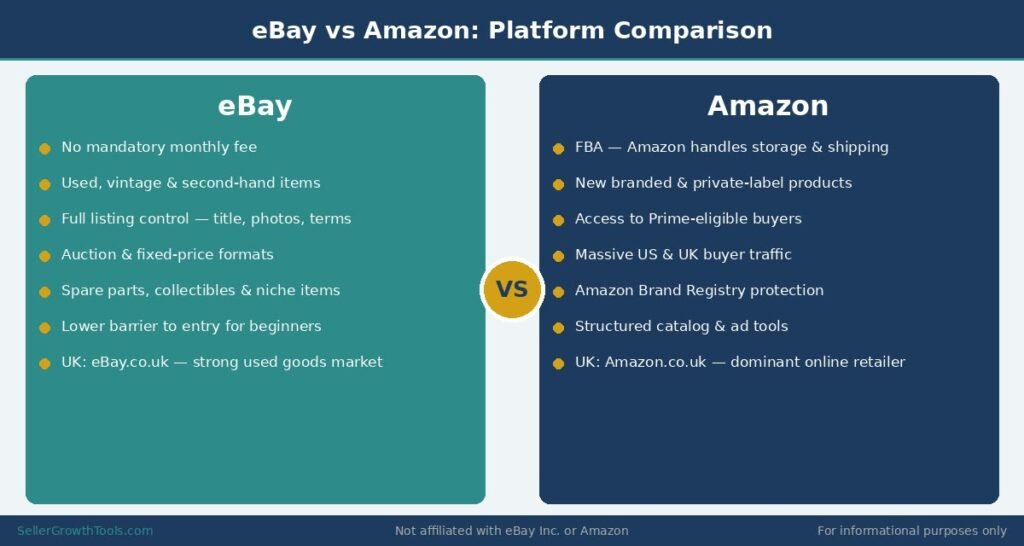
The type of product you sell is often the clearest guide to which platform suits you better.
eBay is generally stronger for:
- Used and second-hand items. eBay’s format and audience are built around pre-owned goods. Buyers expect and search for used items, and individual condition descriptions are standard.
- Collectibles and niche categories. Trading cards, sports memorabilia, vintage clothing, coins, stamps, antiques and similar items have a dedicated and active eBay buyer base.
- Refurbished electronics. Buyers looking for refurbished phones, laptops and other devices often turn to eBay, where graded listings with detailed condition notes are common.
- Car parts and accessories. eBay’s Parts & Accessories category is one of its largest and most active.
- Unique or one-of-a-kind items. Because each eBay listing stands on its own, sellers of unique items are not competing for a shared catalog page.
Amazon is generally stronger for:
- New branded products. Buyers on Amazon typically expect new items and often search by brand.
- Private-label products. Sellers who manufacture or source their own branded products benefit from Amazon’s structured catalog, Brand Registry protection and advertising tools.
- Consumables and repeat-purchase products. Amazon’s subscription and auto-delivery features drive repeat purchases for categories like supplements, household goods and personal care.
- High-volume commodity goods. Products with steady, predictable demand and good margins are well suited to FBA at scale.
Competition and Listing Visibility
eBay and Amazon handle competition very differently.
On eBay, each seller creates their own listing. When a buyer searches for a product, they see multiple individual listings from different sellers, each with its own photos, title, description and price. This means your listing competes on its own merits — your title, images, price and feedback score all affect how often you appear in search results and how buyers respond to your listing.
On Amazon, most products are tied to a shared catalog page. Multiple sellers can offer the same product on a single listing, and Amazon’s algorithm determines which seller’s offer appears most prominently in the “Featured Offer” (also called the buy box). Price, fulfillment method, seller metrics and account health all influence who wins the featured position.
For new sellers, this means that listing a product on Amazon that is already sold by many other sellers — or by Amazon itself — makes it very difficult to gain visibility. On eBay, a new seller with a well-written listing, competitive price and good photos can appear alongside established sellers from day one.
Seller Protection, Returns and Account Policies
Both platforms have policies designed to protect buyers, which means sellers need to understand their responsibilities before listing.
eBay operates the eBay Money Back Guarantee, which protects buyers who receive items that do not match the listing description, or items that do not arrive. Sellers are expected to resolve issues with buyers directly where possible. If a case is opened and decided in the buyer’s favour, eBay may refund the buyer using the seller’s funds.
eBay also tracks seller performance through defect rates, late shipment rates and cases closed without seller resolution. Poor performance can result in lower search visibility, selling restrictions or account suspension.
Amazon has strict seller performance standards covering order defect rate, late shipment rate and cancellation rate. Amazon strongly favors buyers in disputes, and sellers can find accounts suspended or funds withheld if metrics fall below required thresholds. Amazon also has category-specific policies, intellectual property complaint processes and product compliance requirements that can result in listing removals.
Neither platform unconditionally protects sellers, and new sellers on both platforms should read the relevant policies before listing.
Selling on eBay vs Amazon in the USA and UK
US Sellers (eBay.com vs Amazon.com)
In the UK, eBay.co.uk and Amazon.co.uk both have substantial buyer audiences. Amazon.co.uk is the leading online retailer, but eBay.co.uk remains particularly strong for used goods, collectibles and parts — categories where Amazon is less dominant.
UK sellers should note:
- eBay.co.uk fees are quoted in GBP and differ slightly from US rates in some categories
- Amazon.co.uk’s Professional selling plan costs £25 per month plus VAT
- Both platforms require UK business sellers to comply with UK consumer protection laws, including the 14-day right to cancel for most online purchases
- UK sellers operating on both platforms need separate shipping and return policies configured for each
See eBay Business Policies for how to set up correct return and shipping terms for eBay.co.uk.
Can You Sell on Both eBay and Amazon?
Yes — and many established sellers do. Running both platforms simultaneously allows you to reach different buyer audiences and reduce dependency on a single marketplace.
The main practical challenges are:
Inventory management. If you sell the same item on both platforms and it sells on one, you must remove it from the other before someone else buys it. Overselling — where the same unit sells twice — leads to cancellations, negative feedback and potential account penalties. Multi-channel inventory tools can automate this, but they add cost and complexity.
Time and operations. Managing two marketplaces means handling two sets of listings, messages, returns and performance metrics. This is manageable with the right processes but requires planning.
Separate policies. Each platform has its own rules for returns, shipping and listings. What is acceptable on one platform may not be on the other.
For most new sellers, it makes sense to start on one platform, build experience and cash flow, and expand to the second once the first is running smoothly.
Final Verdict: eBay or Amazon?
There is no universally correct answer — the right platform depends on what you are selling, how you plan to fulfill orders and your available budget.
Choose eBay if you:
- Are selling used, second-hand, vintage or collectible items
- Want to start with no monthly fee and minimal upfront commitment
- Prefer to manage your own listings and shipping
- Are testing a product idea before investing in larger inventory
- Sell spare parts, components or niche items
Choose Amazon if you:
- Sell new, branded products in mainstream categories
- Plan to use FBA and want Amazon to handle shipping and returns
- Are building a private-label brand
- Want access to Amazon Prime buyers
- Can commit to consistent inventory and the monthly Professional plan fee
Use both if you:
- Have scalable inventory suitable for multiple platforms
- Want to reduce reliance on a single marketplace
- Have processes in place to manage inventory across channels
For most sellers starting out, eBay is the lower-risk entry point. Once you understand how online selling works and have identified products with proven demand, Amazon becomes a logical next step for scaling.
Frequently Asked Questions
Is eBay or Amazon better for beginners?
eBay is generally better for beginners. There is no mandatory monthly subscription, no gating process for most categories and no requirement to send inventory to a warehouse. You can start with items you already own and scale from there.
Is it cheaper to sell on eBay or Amazon?
For low-volume sellers, eBay is typically cheaper because there is no monthly fee. For high-volume sellers using FBA, total costs on both platforms are often comparable — eBay’s final value fees can be similar to Amazon’s referral fees, though Amazon adds fulfillment costs that eBay does not.
Which marketplace is more profitable?
Profitability depends on your product, category, fulfillment method and volume. As the example above shows, eBay and Amazon FBA can produce similar per-unit profit on new items. For used goods, eBay typically offers better margins because there is less direct competition from identical new items.
Does Amazon have more buyers than eBay?
In terms of total US traffic, yes — Amazon attracts considerably more monthly visitors than eBay. However, buyer intent varies by product category. For used items, collectibles and parts, eBay often has more relevant and motivated buyers than Amazon.
Can I sell the same products on both platforms?
Yes, but you need to manage inventory carefully to avoid selling the same item twice. If you are selling unique items (such as individual used goods), you will need to delist from one platform as soon as a sale occurs on the other.
Is Amazon FBA better than selling on eBay?
FBA removes day-to-day shipping tasks and makes your listings eligible for Prime, which increases conversion for many products. However, FBA involves upfront costs, storage fees and the need to send inventory to Amazon in advance. For low-volume sellers or those selling used items, eBay with self-managed shipping is often simpler and more flexible.
Related Guides & Tools
A complete breakdown of eBay’s fees for UK and US sellers — insertion fees, final value fees, and Store subscription costs.
Calculate your exact eBay fees before you list — enter your selling price and category to see what you’ll pay.
Work out your profit margin and return on investment for any eBay listing, including fees and shipping costs.
Estimate your postage costs for UK and US eBay orders before you decide on your shipping charge.
How to set up reusable shipping, payment and return policy templates for US and UK eBay listings.
Muhammad Usman
eCommerce & SEO Specialist
Muhammad Usman is an eCommerce and SEO specialist with hands-on experience managing eBay, Amazon and other online marketplaces. He creates practical guides and free seller tools designed to help online sellers understand fees, shipping, profitability and day-to-day marketplace operations.
We use official platform documentation as a primary source when researching seller policies, fees and requirements. More about this site · Get in touch