You made an eBay counter offer. The seller didn’t accept it — but didn’t decline it either. Instead a new number came back, and now you’ve got 48 hours to decide.
That’s an eBay counter offer, and it’s where most negotiations on the platform are actually settled. Neither side gets their first number. Both usually end up somewhere reasonable.
This guide covers how counter offers work on both sides: the rules, the timing, what happens if you ignore one, and how to make yours more likely to be accepted.
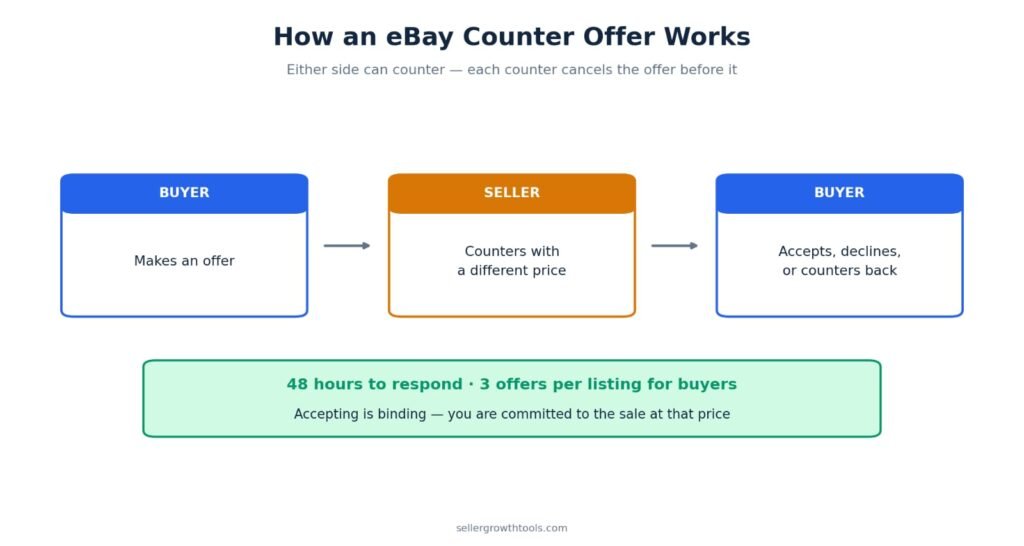
The Short Answer
A counter offer is a response to an offer with a different price
Either side can send one
You get 48 hours to respond before it expires
Accepting a counter offer commits you to buy or sell — it’s binding
Sending a counter offer cancels the offer it responds to
Best Offer vs Counter Offer: What’s the Difference?
These get confused constantly, so it’s worth separating them.
Best Offer is the feature. A seller switches it on for a listing, which lets buyers propose a price instead of paying the fixed one. Without Best Offer enabled, there’s nothing to negotiate.
Counter offer is a move within that negotiation. When an offer comes in and neither party wants to accept or walk away, they send back a different number.
Put simply:
Best Offer = the door being open
Counter offer = the conversation that happens once you’re through it
If you’re setting up Best Offer on your listings — including Auto Accept and Auto Decline thresholds — that’s covered in full in our eBay Best Offer Guide. This page focuses on what happens once offers start moving back and forth.
How a Counter Offer Actually Works
The 48-hour window
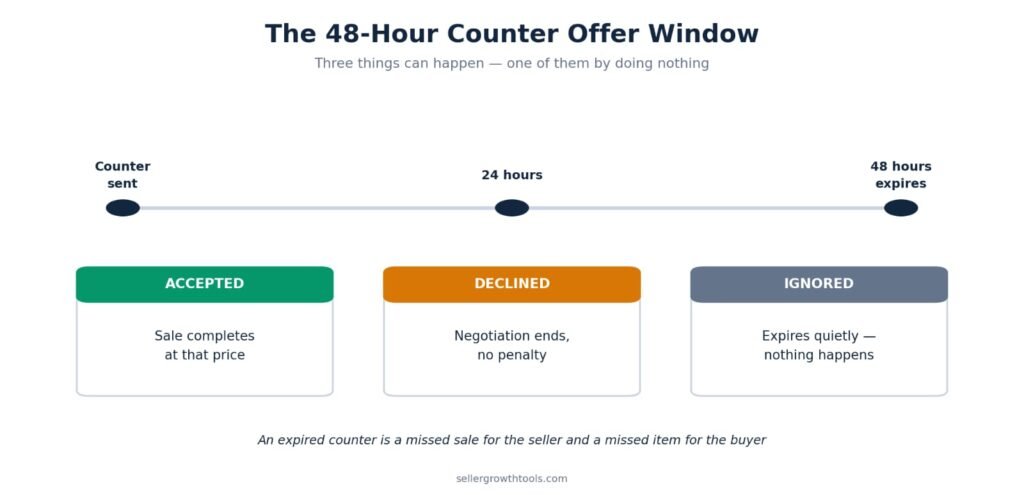
Every counter offer expires after 48 hours.
Three things can happen in that window:
Accepted — the sale completes at that price
Declined — the negotiation ends, though a new offer can usually be started
Ignored — it expires and nothing happens
There’s no penalty for letting one expire, which is why plenty of them simply run out. But an expired counter offer is a missed sale for the seller and a missed item for the buyer, so it’s worth answering even if the answer is no.
How many rounds you get
Buyers typically get three offers per listing. That total includes counter offers you send back.
So a realistic negotiation looks like:
Buyer offers
Seller counters
Buyer counters
Seller counters
Buyer accepts or walks
Most deals close within two or three rounds. If you’re past that, the gap between you is usually too wide to bridge.
Sellers have more room and can counter as many buyers as they like on a listing — though there’s a practical limit worth knowing about, covered below
Is a counter offer binding?
Yes. This is the part people underestimate.
Accepting a counter offer creates a contract. As a buyer you’re committed to paying; as a seller you’re committed to selling at that price.
You can’t accept and then change your mind because you found the item cheaper elsewhere, or because a better offer arrived five minutes later. Backing out means an unpaid item case for buyers, or a cancellation defect for sellers.
Don’t send a number you’re not prepared to honor.
Counter Offers for Buyers
When you receive one
You’ll get an email and a notification. To find it: My eBay → Buying → Offers.
You’ll see the seller’s counter price and how long is left on the clock.
Three options:
Accept — you’re buying at that price, immediately
Decline — the negotiation ends
Counter — send a new number back
Countering back
If you counter, you’re proposing a price between the two positions. Whether that works depends almost entirely on how far apart you are.
A useful rule: if you’re within 10% of each other, split it. Sending a number close to the middle usually closes the deal. Trying to claw back another 15% at that stage often just kills it.
What happens to your original offer
Your original offer is gone the moment the seller counters. Countering back doesn’t revive it.
That matters because it means you can’t counter, get declined, and then go back to your first price. Once you’ve moved, you’ve moved.
Counter Offers for Sellers
Sending a counter offer
When an offer comes in: My eBay → Selling → Offers, then select the offer and choose Counter.
Set your price and send. The buyer has 48 hours.
You can add a short message with your counter, and it’s worth doing. “Best I can do at this price, item is in excellent condition” converts noticeably better than a bare number. It costs nothing and gives the buyer a reason to say yes.
Countering multiple buyers at once
If several offers land on the same listing, you can counter all of them.
But be careful here. If two buyers accept, you’re contractually committed to both — and you only have one item. One of them is getting a cancellation, and that comes with a defect on your account.
Two safer approaches:
Counter one buyer at a time, waiting out the 48 hours before moving to the next
Only counter multiple buyers if you have multiple units of that item
The first is slower. The second is safer. Countering five buyers on a single item to see who bites is how sellers end up with a Below Standard rating — see our Below Standard Rating Guide for what that costs.
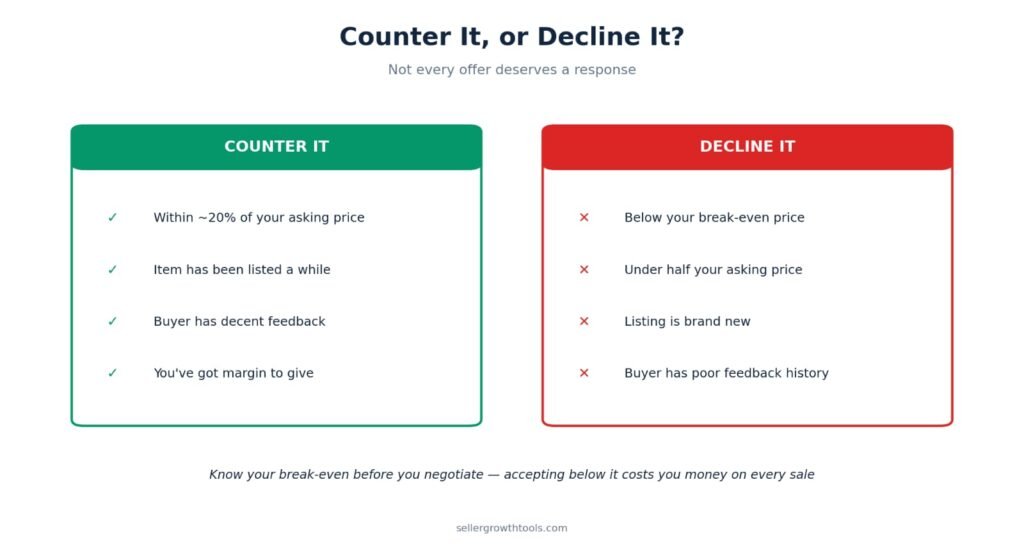
When to counter and when to decline
Not every offer deserves a counter.
Counter when:
The offer is within roughly 20% of your asking price
The item has been listed a while without selling
The buyer has decent feedback
You’ve got margin to give
Decline when:
The offer is below your break-even
It’s a low ball — under half your asking price
The item is new to the listing and hasn’t had time to sell
The buyer has a poor feedback history
That first decline point deserves a moment. Plenty of sellers accept offers that look acceptable and only work out afterwards that fees and postage ate the difference. Know your floor before you negotiate — our eBay Fee Calculator gives you the net payout on any price, so you can see exactly where accepting stops making sense.
A Real Negotiation, Step by Step
Here’s how a typical exchange plays out on a £130 listing.
Round 1 — Buyer offers £100
About 77% of asking. Low, but not insulting. Worth a response.
Round 2 — Seller counters £115
Not the full £130, but a real move. Signals willingness to negotiate without giving everything away.
Round 3 — Buyer counters £110
Splitting the remaining gap. This is where most deals land.
Round 4 — Seller accepts
£110 on a £130 listing. The seller loses £20 off asking but makes the sale — and had already worked out that £110 still cleared their costs.
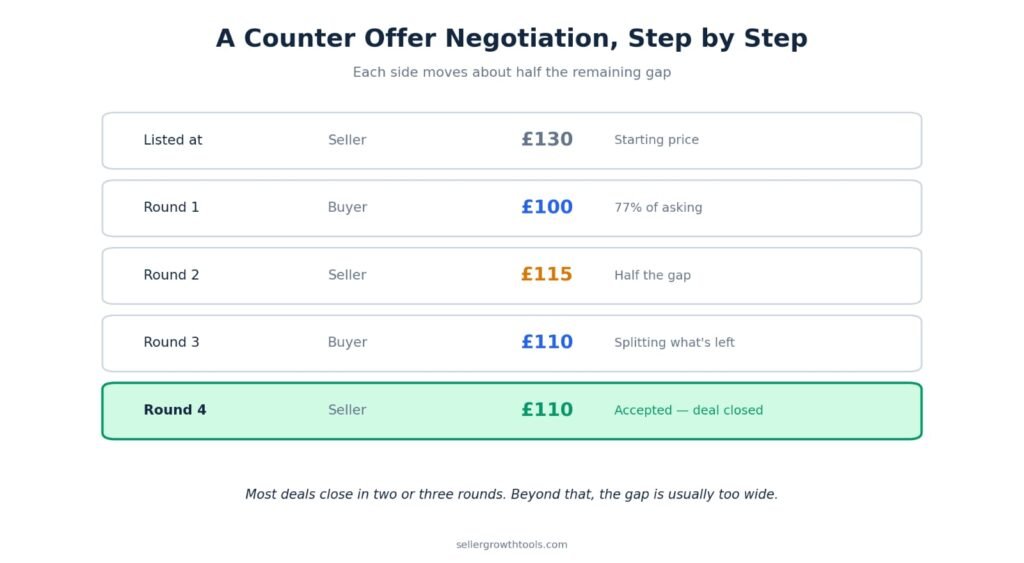
The pattern is consistent: each side moves roughly half the remaining gap each round. Negotiations that follow that shape tend to close. Ones where somebody holds firm usually expire.
Tips to Get Your Counter Offer Accepted
For buyers
Check what it actually sold for. Filter completed listings by Sold, and look at what the item genuinely goes for rather than what other sellers are asking. An offer anchored to real sold prices is far harder to refuse.
Don’t open too low. Anything under half the asking price usually gets declined without a counter. You’ve spent one of your three offers for nothing.
Aim for 10–20% below asking on your first offer. That’s the range sellers typically engage with.
Look at how long it’s been listed. An item that’s been sitting for weeks has a more motivated seller than one listed yesterday.
Say something. A one-line message — “Would you take £110? Happy to pay straight away” — performs better than a silent number. Immediate payment is genuinely worth something to sellers.
For sellers
Respond quickly. Buyers making offers are often looking at several similar items. A counter that arrives in an hour lands very differently to one that arrives on day two.
Make a real move. Countering £128 on a £130 listing after a £100 offer reads as a refusal. If you’re going to counter, move enough to look like you mean it.
Add a reason. “This includes tracked postage” or “Only one left in this size” gives the buyer something to weigh beyond the number.
Know your floor first. Work out the price at which fees, postage and product cost leave you break-even. Negotiate down to that number, never below it.
Why You Might Not See the Counter Offer Option
Several reasons the button might be missing:
Best Offer isn’t enabled on that listing — no offers, no counters
You’ve used all three offers on that listing as a buyer
The offer already expired — the 48 hours ran out
The item sold to someone else while you were deciding
Auto Decline is set above your offer, so it was rejected automatically before the seller saw it
The listing ended or was revised by the seller
That Auto Decline point catches out a lot of buyers. If your offer disappears instantly with no seller involvement, it hit an automatic threshold rather than a person.
Frequently Asked Questions
How long does an eBay counter offer last?
48 hours. After that it expires automatically and nothing happens to either party.
Can you counter offer twice on eBay?
As a buyer you get three offers per listing in total, including counters — so you can counter twice after your original offer. Sellers can counter more freely.
Is an eBay counter offer binding?
Yes. Accepting one commits you to the purchase or sale at that price. Backing out results in an unpaid item case or a cancellation defect.
What happens if I ignore a counter offer on eBay?
It expires after 48 hours with no penalty. The negotiation simply ends.
Does a counter offer cancel my original offer?
Yes. Once either side counters, the previous offer is void and can’t be revived.
Can a seller send a counter offer to multiple buyers?
Yes, but it’s risky. If more than one accepts, you’re committed to all of them and will have to cancel — which brings a defect. Only do this if you have multiple units.
What percentage should I counter offer on eBay?
As a buyer, 10–20% below asking is the range sellers usually engage with. Once you’re negotiating, moving about half the remaining gap each round tends to close deals.
Why can’t I counter offer on eBay?
Best Offer isn’t enabled, you’ve used all three offers, the offer expired, the item sold, or your offer hit the seller’s Auto Decline threshold.
Can I cancel a counter offer after sending it?
Not usually. Once sent, it stands until the other party responds or the 48 hours run out. Send numbers you’re prepared to honor.
Do counter offers affect my eBay fees?
The fee is calculated on the final sale price, so a lower accepted price means a lower fee in absolute terms — but the same percentage rate applies.
Counter offers are where most eBay negotiations are actually settled, and the mechanics matter on both sides. Know that you’ve got 48 hours, that three offers is the buyer’s limit, and that accepting is binding.
Beyond that it’s straightforward: move in meaningful steps, respond quickly, and know your floor before you start.
Work out your floor before you negotiate:
eBay Fee Calculator · eBay ROI Calculator
eBay officials help pages
Related Guides
Auto-accept and auto-decline settings, and how the whole system works.
Find your break-even price before you counter — never go below it.
Check what similar items actually sold for before accepting or countering.
See what a lower accepted offer leaves you after fees and postage.
Getting lowball offers usually means the listing is attracting the wrong buyers.
|
MU
|
Written by Muhammad Usman eCommerce Specialist · eBay Seller & SEO Expert Muhammad manages eCommerce operations and SEO for UK sellers across eBay, Etsy, Shopify and TikTok Shop. He has handled thousands of Best Offer negotiations on client accounts, and has watched more sellers lose money by accepting a good-looking offer than by declining a bad one. |