You log into eBay Seller Performance dashboard and there it is — a percentage you didn’t expect, or a seller level that’s dropped. eBay shows you the number. What it doesn’t show you clearly is which sales caused it, why that particular order counted, or what you’re supposed to do now.
That gap is where most of the confusion lives. Sellers spend weeks chasing feedback removal when feedback was never the problem. Others cancel an order to “keep the buyer happy” without realising that cancellation is the exact thing being counted against them.
This covers what eBay actually measures, how the maths works, what counts and what doesn’t, and what genuinely moves the number back down. Thresholds differ between regions and account types, so treat the figures here as the standard published position and confirm your own in Seller Hub.
What eBay Actually Measures
Most sellers assume eBay is watching their feedback score. It isn’t — or at least, not in the way that affects the account. Feedback is what buyers think of you. Seller performance is something separate, and it’s the one that decides your seller level, your search visibility, whether you qualify for Top Rated, and in serious cases whether your account gets restricted.
There are three measurements. They get listed differently across various guides, which is part of why this is so confusing.
Transaction Defect Rate
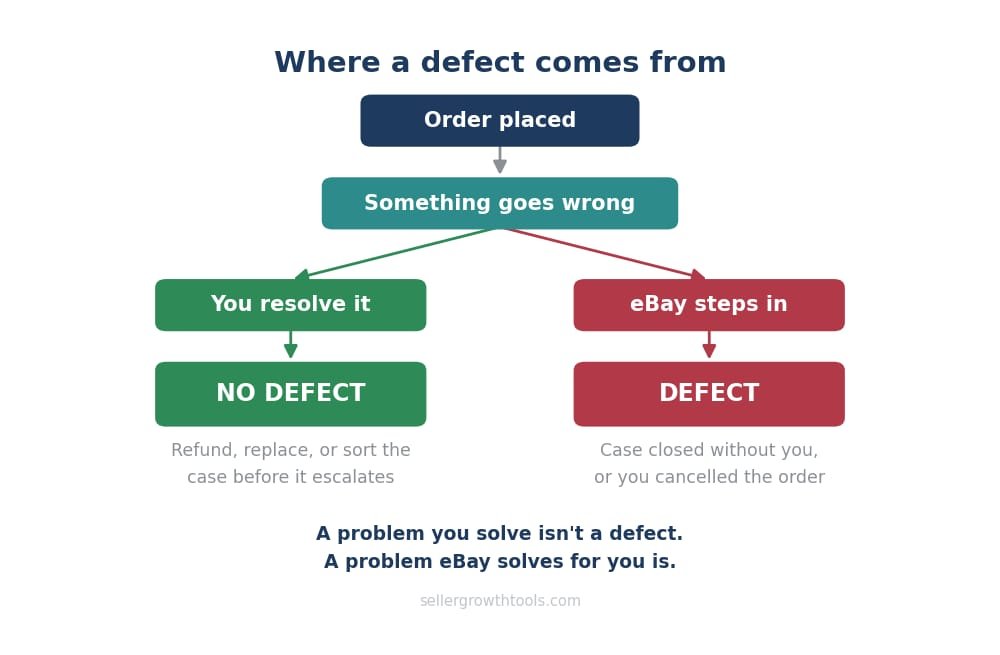
This is the main one, and it’s made up of two things — not one. A transaction picks up a defect when either of these happens:
You cancel the order. Out of stock, priced wrong, item damaged before dispatch — if the cancellation comes from your side, it counts.
A case is closed without you resolving it. The buyer opened a Money Back Guarantee case, you didn’t sort it, and eBay stepped in and decided.
Both roll into one percentage. That’s your transaction defect rate, and it’s the number that most often pushes sellers below standard.
One transaction, one defect. If a single order goes wrong in several ways, it still counts once. eBay measures transactions, not individual problems.
Late Shipment Rate
This tracks whether orders leave on time, measured against the handling time you set on the listing.
Two things can mark an order late: a carrier scan that lands after your dispatch deadline, or no tracking at all combined with a buyer reporting late arrival. The second catches sellers out constantly. Post without tracking and you have nothing to point at when the buyer says it took a fortnight.
This sits apart from your defect rate. A late dispatch doesn’t create a defect, but it damages your seller level on its own.
Tracking Upload and Validation
Four checks here: whether tracking was uploaded at all, whether it went up before your dispatch deadline, whether the carrier is one eBay recognises, and whether the number actually scanned.
A tracking number that never gets scanned is treated much like no tracking. Buying a label and leaving the parcel in a drawer for three days doesn’t help — the first carrier scan is what eBay records, not the moment you printed the label.
How they fit together
| What happened | Counts toward |
|---|---|
| You cancelled — out of stock | Transaction defect rate |
| Case closed without your resolution | Transaction defect rate |
| Dispatched after your handling time | Late shipment rate |
| No tracking, buyer reports late arrival | Late shipment rate |
| Tracking missing, late or never scanned | Tracking validation |
How the Defect Rate Is Calculated
Here’s the part almost nobody explains properly, and it’s the reason the number often looks worse than sellers expect.
Your defect rate is calculated on transactions. Not listings. Not items. Not orders in the loose sense. If a buyer purchases four of the same item in one order, that’s one transaction. If four separate buyers each purchase one, that’s four.
The sum is simple enough: Defects ÷ Total transactions × 100 = Defect rate %
So 3 defects across 200 transactions gives you 1.5%. Comfortable enough. The same 3 defects across 40 transactions gives you 7.5%, which is well into Below Standard territory.
That difference is the whole story for smaller sellers. eBay applies the same percentage thresholds to someone shifting 30 items a month as it does to someone shifting 3,000, and the maths is brutal at low volume. One out-of-stock cancellation on a quiet month can put you over on its own.
What a single defect does to your rate:
| Transactions in period | One defect = | Position |
|---|---|---|
| 25 | 4.0% | Over the line |
| 50 | 2.0% | Right at the line |
| 100 | 1.0% | Fine |
| 250 | 0.4% | Still Top Rated range |
| 500 | 0.2% | Barely registers |
eBay does apply a minimum-buyer condition before dropping an account, so a single defect on a tiny account usually won’t demote you outright. But the percentage still sits there on your dashboard, and it still has to be diluted by clean sales before it moves.
Which leads to a slightly counterintuitive point: selling more is one of the more reliable ways out of a bad defect rate. Not because the defects disappear, but because the denominator grows.
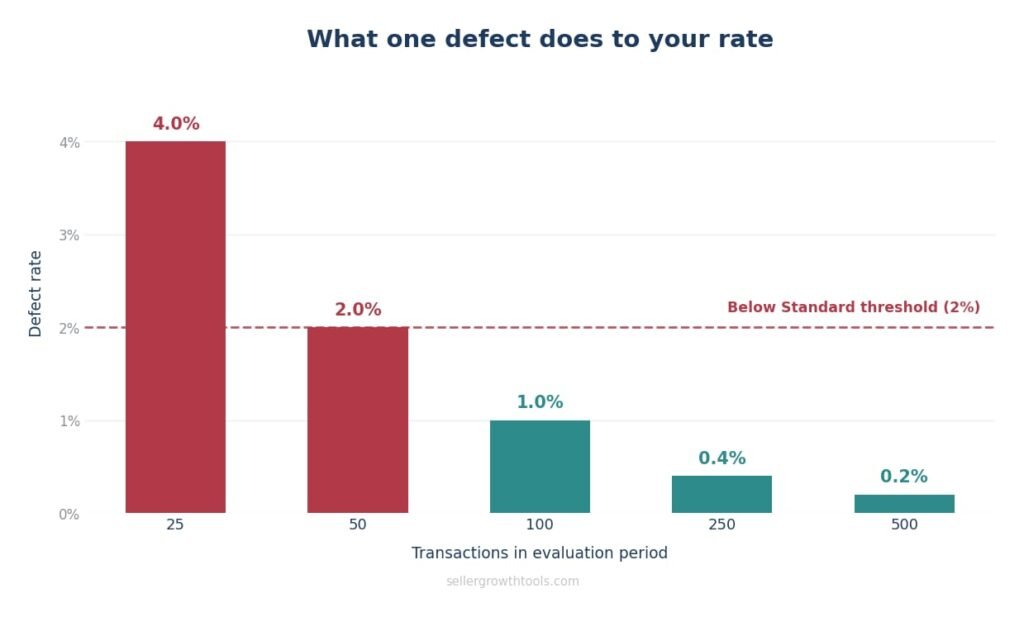
Red horizontal line at 2.0% labelled “Below Standard threshold”
Bars above line red, below line teal, white background
What Counts as a Defect (and What Doesn’t)
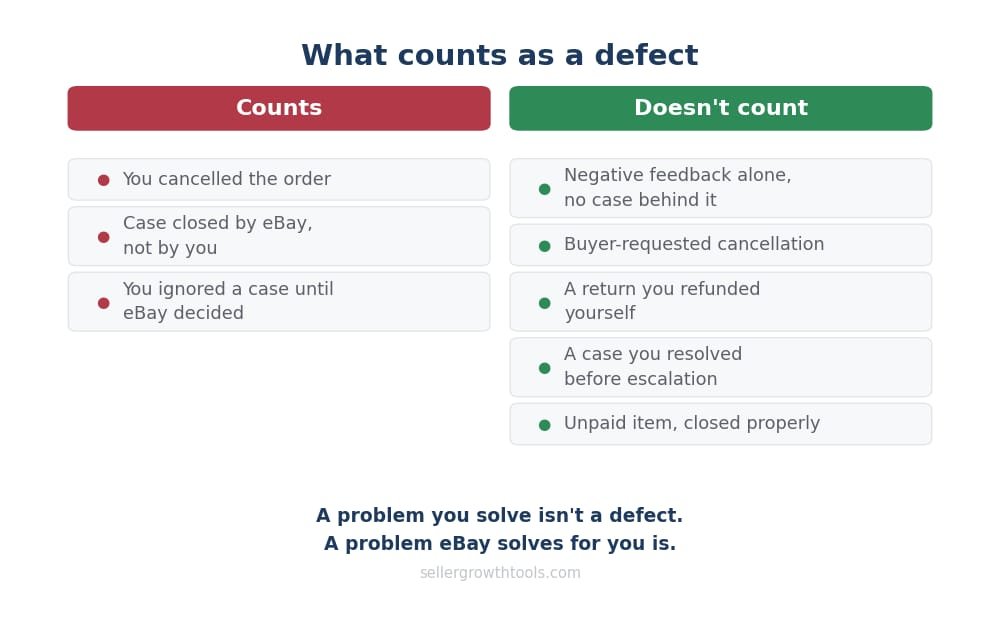
This is where most of the panic happens, and a lot of it is unnecessary
You cancelled because the item was out of stock
You cancelled because you’d priced it wrong and didn’t want to honour it
A buyer opened an item-not-received case and eBay closed it in their favour
A buyer opened a not-as-described case and eBay stepped in to resolve it
You ignored a case until eBay made the decision for you
Doesn’t count
Negative feedback on its own, with no case behind it
A cancellation the buyer requested, processed correctly through the proper flow
A return you accepted and refunded yourself, without escalation
A case you resolved before eBay got involved
A buyer who never paid, closed properly as an unpaid item
Low detailed seller ratings on their own
The pattern is worth internalising: a problem you solved isn’t a defect — a problem eBay had to solve for you is. Almost every avoidable defect comes down to not responding in time.
Seller Levels and Where You Sit
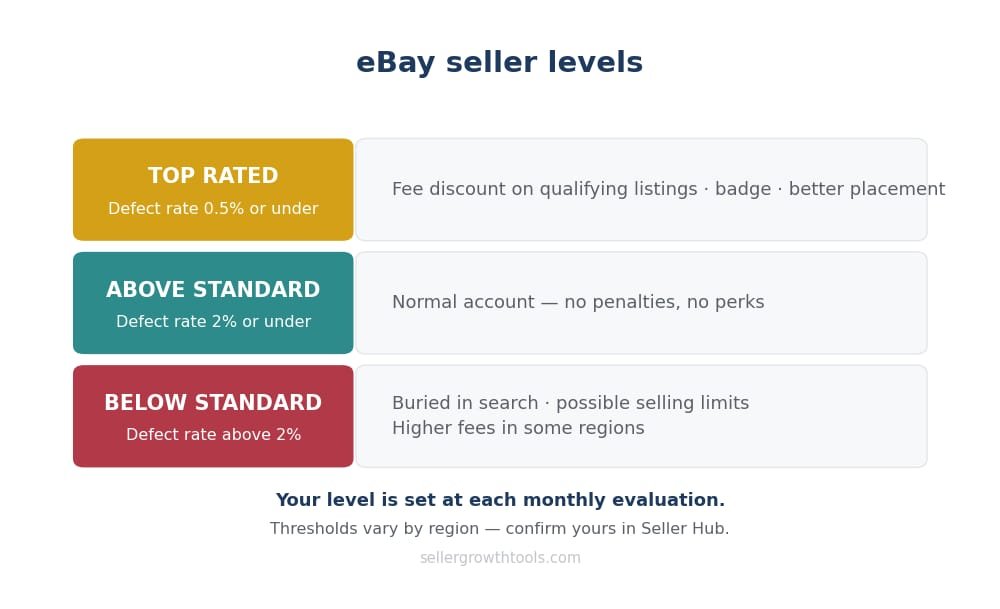
Three levels, and they’re not just badges — each one changes what your account costs and how visible it is.
| Level | Roughly requires | What it means |
|---|---|---|
| Top Rated | Defect rate ≤0.5%, late shipment ≤3%, tracking validated on ≥95%, plus minimum transactions and sales value over 12 months | Fee discount on qualifying listings, a visible badge, better placement |
| Above Standard | Defect rate at or under 2%, late shipment at or under 10% | Normal account, no penalties, no perks |
| Below Standard | Defect rate above 2%, or late shipment above 10% | Reduced search visibility, possible selling limits, promotion restrictions, higher fees in some regions |
Exact thresholds and the minimum transaction requirements for Top Rated vary between the UK, US and other markets, and eBay adjusts them periodically. Check the figures on your own Seller Standards dashboard rather than working from a number you read somewhere.
If you’ve already dropped, the recovery route is covered in more depth in our Below Standard guide, and the requirements at the other end are set out in the Top Rated Seller guide.
What Happens if You Drop Below Standard
Below Standard isn’t a warning label. It changes how your account operates, and the effects stack.
Your listings get buried. Search placement drops, and this is the one sellers notice first — usually as a sudden fall in sales with no obvious cause. You’re still listed, just much harder to find.
Selling limits can tighten. eBay may reduce the number of items or the total value you’re allowed to list, and requests to raise them are unlikely to be approved while you’re below standard. If you’re already near a ceiling, this bites immediately. Our selling limits guide covers how those work.
Promotions become restricted. Eligibility for some seller promotions and features can be withdrawn, which removes the tools you’d normally use to push volume back up. Awkward timing, given that clean volume is exactly what dilutes a bad defect rate.
Fees may rise. In some regions eBay applies an additional charge to below standard accounts. Whether it applies to you depends on your market, so check your own fee schedule rather than assuming.
Account restrictions become possible. Sustained poor performance is one of the routes to a restricted or suspended account. If you’ve been hit with an error code blocking your listings, our MC011 guide explains what that specific block means, and the account suspended guide covers the appeal process.
Below Standard is not permanent. It’s reassessed at every monthly evaluation, and accounts recover from it regularly. What it does require is clean transactions over time — there’s no shortcut, and no appeal route for the status itself.
When eBay Evaluates You
Your seller level isn’t recalculated in real time. eBay runs a formal evaluation once a month, and that’s when your level can actually change.
The data it pulls covers a rolling period rather than the last few weeks. Higher-volume sellers are typically assessed over roughly twelve months; lower-volume accounts over a shorter recent window. The exact split and the evaluation date vary by region, so confirm yours in Seller Hub.
Two practical consequences fall out of this.
First, a defect from months ago is still in your calculation. You can’t outrun it by having a good week.
Second — and this one matters more — fixing your process today doesn’t fix your number today. If you tighten up your dispatch and stop cancelling orders, you’re waiting for the old transactions to age out and new clean ones to build up. That’s weeks, sometimes months. Sellers give up on good habits because the dashboard hasn’t moved yet. Don’t.
How to Remove a Defect
Honestly? Most removal requests fail. It’s worth trying when you have genuine grounds, and it’s worth not wasting your afternoon when you don’t.
Grounds that sometimes work
The buyer breached an eBay policy — abusive behaviour, extortion attempts, a demand for something outside the listing terms
There’s a documented carrier or eBay system failure behind it
Something outside anyone’s control affected delivery in your area, and eBay has acknowledged it
You can evidence that you dispatched on time and the tracking proves it.
Grounds that won’t
The buyer was unreasonable” with nothing to show for it
You cancelled to be helpful and now regret it
It was your first ever defect
The refund was small
You’ve been selling for years without problems
Before you contact eBay, get your evidence together. Vague complaints go nowhere; a dated message thread and a tracking record occasionally do. Keep it factual and short — the person reading it is working through a queue.
Something worth remembering: a defect you can’t remove will drop off on its own once it ages out of the evaluation window. Sometimes waiting is the strategy.
How to Lower Your Defect Rate
Practical things, in rough order of how much difference they make.
Stop cancelling orders. This is the big one, and it’s entirely within your control. Out-of-stock cancellations are the most common defect there is, and they come from inventory that isn’t tracked properly. If you sell the same item across multiple platforms, that’s where it usually goes wrong.
Answer cases within a day. A case you resolve isn’t a defect. A case eBay resolves is. The difference between those two outcomes is often just whether you opened the message. Set a reminder if you need to.
Pad your handling time. If you can usually post next day, state two days. You lose a small amount of search preference and gain a buffer for the day you’re ill, the printer jams, or the post office queue is out the door. Late dispatch is entirely avoidable with honest handling times.
Upload tracking as you go. Not at the end of the week. The scan timestamp is what eBay reads, and a label printed on Monday with a first scan on Thursday looks exactly like a late dispatch.
Refund rather than argue. On a low-value item, a quick refund costs you a few pounds. A case eBay closes costs you a defect that sits on your account for months. The maths is usually obvious once you frame it that way.
Keep selling. Clean transactions dilute the percentage. Pausing your listings while you “sort things out” freezes the denominator and keeps the bad number exactly where it is.
Defect Rate vs Feedback Score
Two separate systems, and conflating them wastes an enormous amount of seller time.
Feedback is public opinion. It’s visible on your profile, buyers read it, and it affects whether someone buys from you. It does not, on its own, affect your seller level.
Defect rate is private transaction data. Buyers never see it. It decides your seller level, your fees, and your search placement.
You can hold a 100% feedback score and be Below Standard. You can have a handful of negatives and be Top Rated. They measure different things.
If a negative is the actual problem — because it’s putting buyers off — that’s a separate job, covered in our negative feedback removal guide. Just don’t expect removing it to move your defect rate, because it won’t.
UK vs US: What’s Different
The framework is the same on both sides — same three measurements, same three levels, same monthly cycle. The detail underneath is where they part company, and a lot of bad advice online comes from people applying US figures to a UK account or the reverse.
What’s the same
Defect rate, late shipment rate and tracking validation are the measurements in both markets
Top Rated, Above Standard and Below Standard are the levels
Evaluation runs monthly, on a rolling data window
A defect is a defect for the same reasons — cancellations and unresolved cases.
What differs
Top Rated qualification. Both markets set a minimum transaction count and a minimum sales value over the preceding twelve months, but the value threshold is set in local currency and the exact figures aren’t identical. Check the requirement on your own dashboard rather than converting a number you read for the other market.
What Top Rated gets you. The fee discount and how it’s applied differs between markets, and it’s usually attached to listings that meet specific criteria rather than to the account as a whole. Postage and returns conditions attached to those qualifying listings also vary.
Below standard fees. Additional charges for below standard accounts exist in some markets and not others.
Carrier validation. Which carriers eBay accepts as providing valid tracking depends on the market you’re selling in. A carrier that validates cleanly on a US account may not on a UK one, which matters if you’re selling cross-border.
Postage expectations. Delivery timeframe norms differ, and that feeds into how late shipment gets judged in practice.
If you sell on both eBay.co.uk and eBay.com, treat them as separate accounts with separate standards. Performance on one doesn’t carry across to the other, and the thresholds you need to hit aren’t interchangeable.
Weekly Performance Checklist
Ten minutes on a Monday keeps most of this under control:
Check Seller Hub for any open case — deal with it before eBay does
Confirm every order from last week has tracking uploaded and scanned
Reconcile stock across every platform you sell on
Check nothing is listed that you can’t actually dispatch this week
Review your handling time against how you actually posted last week
Open your Seller Standards dashboard and note the direction of travel
Frequently Asked Questions
What is a good defect rate on eBay?
Under 0.5% is the level associated with Top Rated status. Anything at or below 2% keeps you Above Standard. Above 2% typically puts you at risk of being dropped to Below Standard, subject to eBay’s minimum buyer conditions.
How long does a defect stay on my account?
Until it ages out of your evaluation window. For most sellers that’s a rolling period of several months to a year, depending on volume and region. It isn’t removed early just because your recent performance has improved.
Does negative feedback count as a defect?
No. Feedback and defects are separate systems. A negative comment with no case behind it has no effect on your defect rate or your seller level, though it is visible to buyers.
What are the eBay seller levels?
Top Rated, Above Standard and Below Standard. Your level is set by your defect rate, late shipment rate and tracking validation, assessed at each monthly evaluation
Can I appeal a defect?
You can request removal, but it’s only granted on narrow grounds — buyer policy breaches, documented carrier or eBay system failures, or events outside your control that eBay has acknowledged. Have your evidence ready before you contact them.
How often does eBay evaluate seller performance?
Monthly. The evaluation date and the length of the rolling data window vary by region, so check your own dashboard in Seller Hub.
How do I check my seller performance on eBay?
Open Seller Hub and go to the Performance tab, then Seller Standards. It shows your current level, your defect rate, late shipment rate and tracking validation, along with the date of your next evaluation.
What is a defect on eBay?
A defect is a transaction that went wrong in a way eBay counts against you — either you cancelled the order, or a case was closed without you resolving it. It’s recorded against the transaction, not against your feedback.
Muhammad Usman
eCommerce & SEO Specialist
Muhammad works with eBay and marketplace sellers across the UK and US, handling listings, fee structures and store optimisation day to day. He writes these guides because most eBay advice online explains the rule without explaining what to actually do about it.
Every guide here is checked against eBay’s current documentation before publishing and revisited when policies change. More about this site · Get in touch