Quick Answer: A eBay Below Standard rating means eBay has flagged your account for falling outside one or more seller performance thresholds — usually your transaction defect rate, late shipment rate, or the percentage of cases eBay had to close on your behalf. It’s not a suspension. You can generally keep selling, but with reduced limits and lower visibility in search until your numbers recover. Most sellers climb back to Above Standard within one to three monthly evaluation cycles once the underlying issue is fixed.
Key Takeaways
eBay recalculates seller standing roughly once a month, but your actual rating is based on a rolling 3-month window (12 months for Top Rated eligibility)
Very low-volume sellers usually aren’t evaluated at all until they hit a minimum transaction threshold
You can almost always keep selling while Below Standard — it limits you, it doesn’t shut you down
Most defects age out naturally once they fall outside the evaluation window, no action required
The fastest fix is identifying the exact defect in Seller Hub and addressing the root cause, not guessing.
Table of Contents
- What Is eBay’s Seller Performance Standard?
- The 3 Metrics That Determine Your Rating
- How eBay Calculates Your Evaluation Period
- Common Reasons Sellers Become Below Standard
- What Happens When You’re Rated Below Standard
- Can You Sell While Below Standard?
- Country-Specific Notes
- How to Fix a Below Standard Rating
- How to Prevent It From Happening Again
- Worked Example
- Frequently Asked Questions
- Related Guides
Getting a Below Standard notice from eBay is one of those moments that makes a seller’s stomach drop — especially if you weren’t expecting it. The dashboard suddenly shows a red flag where there used to be a green checkmark, and the first instinct is to panic about whether the account is about to be shut down.
It usually isn’t. A Below Standard rating is eBay’s way of saying your recent numbers slipped below what they consider reliable — not that you’ve done something unforgivable. This guide walks through exactly what triggers it, how eBay’s evaluation timing actually works (which trips up more sellers than the rating itself), and the specific steps to get back to Above Standard.
What Is eBay’s Seller Performance Standard?
Every eBay seller sits in one of three tiers, and where you land depends entirely on how your recent transactions have actually played out — not on how good your listings look or how long you’ve been selling.
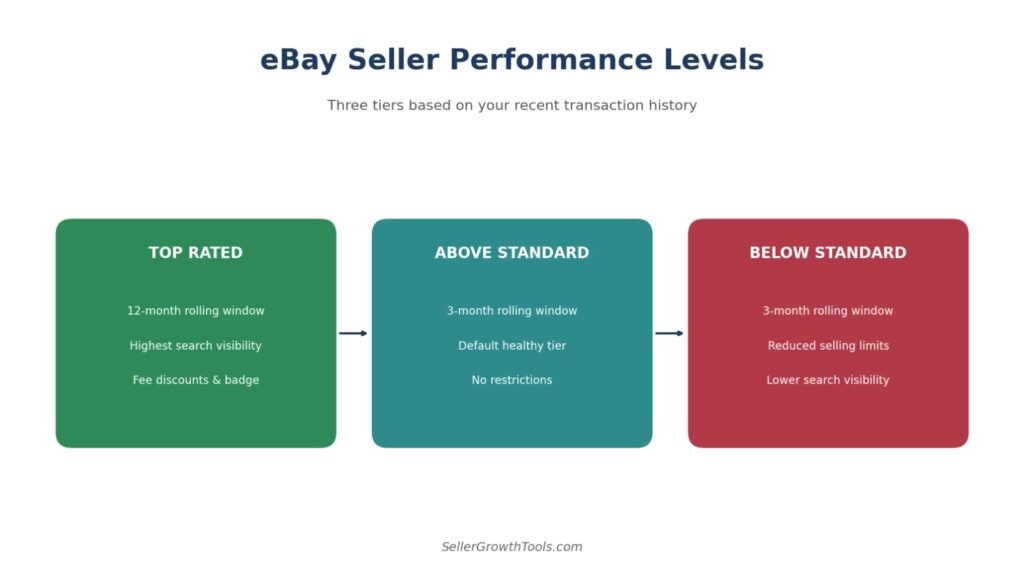
At the top is Top Rated Seller, which comes with a badge, a small final value fee discount, and a visibility boost in search. Most sellers live in the middle tier, Above Standard, which is really just eBay’s default “you’re doing fine” status. Fall below certain thresholds and you drop into Below Standard — the tier that triggers restrictions.
The reason this matters beyond just pride is Cassini, eBay’s search ranking algorithm. It uses seller performance as a real ranking signal, so a Below Standard tag doesn’t just sit quietly in a dashboard — it actively changes how often your listings show up to buyers. For a full breakdown of what Top Rated status unlocks, see our Top Rated Seller Guide.
The 3 Metrics That Determine Your Rating
eBay tracks three numbers on your Seller Standards dashboard, and any one of them falling out of range is enough to trigger a Below Standard rating.
Transaction Defect Rate
This is the percentage of your transactions that had some kind of “defect” — cancellations for being out of stock, cases where eBay determined you were at fault, or payment disputes. To stay Above Standard, this generally needs to stay under 2%.
Late Shipment Rate
The share of orders where tracking shows the item shipped after your promised handling time, or where delivery scans confirm it arrived later than expected. The threshold here is typically under 5%.
Cases Closed Without Seller Resolution
Cases like “item not received” or “item not as described” that eBay had to step in and resolve because the seller didn’t handle it directly with the buyer first. This one has the tightest threshold — generally under 0.3%.
| Metric | Above Standard Threshold | Notes |
|---|---|---|
| Defect rate | Below 2% | Cancellations, disputes, low ratings |
| Late shipment rate | Below 5% | Based on tracking/handling time |
| Cases closed without resolution | Below 0.3% | eBay had to intervene |
How eBay Calculates Your Evaluation Period
This is the part almost every other guide on this topic skips, and it’s usually what confuses sellers the most.
eBay doesn’t just look at “recent” activity in some vague way — it runs on a defined schedule. Your performance standing gets recalculated roughly on the 20th of every month, looking backward over a specific window. That monthly refresh is exactly why a rating can shift even when you haven’t changed anything — old transactions simply age out of the window and new ones age in.
For the standard Above Standard / Below Standard determination, eBay looks at your trailing 3 months of transactions. It’s a rolling window, so anything older than that stops counting against you automatically. Top Rated Seller status works on a longer 12-month rolling window instead, which is why losing standard status can happen fast from a rough few weeks, but earning Top Rated back takes sustained good behavior over a much longer stretch.
There’s also a minimum activity requirement most sellers don’t know about. eBay won’t evaluate — and therefore can’t penalize — accounts with very few transactions in the window. The exact number isn’t published and can vary, but it’s generally understood to be somewhere around 3-4 transactions and roughly $400 in sales. This is why a brand-new seller with one bad transaction almost never gets flagged Below Standard — there simply isn’t enough data yet to trigger an evaluation.
| Evaluation Type | Window | What It Affects |
|---|---|---|
| Monthly snapshot | Refreshed ~20th of each month | When your rating updates |
| Standard rating | Rolling 3 months | Above Standard vs Below Standard |
| Top Rated rating | Rolling 12 months | Top Rated Seller eligibility |
| Minimum activity | Varies (transactions + sales $) | Whether you’re evaluated at all |
Common Reasons Sellers Become eBay Below Standard
In practice, most eBay Below Standard ratings trace back to one of a handful of recurring causes:
Late dispatch — shipping after the handling time you promised, even by a day, if it happens repeatedly
Item not as described — buyers opening cases because the condition, photos, or description didn’t match what arrived
Out of stock cancellations — cancelling an order because inventory wasn’t actually available counts as a seller-side defect
Poor communication — slow responses to buyer messages tend to push unresolved issues into full eBay cases instead of getting settled directly
Invalid tracking — tracking numbers that don’t scan or don’t match the carrier get treated almost the same as having no tracking at all
Most sellers can trace their Below Standard rating back to one, maybe two, of these — which makes the fix a lot more targeted than it first appears.
What Happens When You’re Rated eBay Below Standard
Reduced selling limits — eBay may cap how many items or how much total value you can list per month
Lower search visibility — Cassini pushes your listings down compared to Above Standard and Top Rated sellers
Possible additional restrictions — persistent cases can lead to further limits on specific selling privileges
No Top Rated eligibility — this status is simply unavailable while you’re Below Standard, regardless of your longer-term history.
Can You Sell While eBay Below Standard?
Yes, in almost every case. A Below Standard rating is a performance flag, not a suspension — you’ll typically keep the ability to list and sell, just with tighter limits and less visibility than you’d otherwise have.
When Restrictions Get Tighter
If the issues behind the rating don’t get addressed, eBay can escalate — further reducing selling limits, placing holds on payouts, or requiring open cases to be resolved before new listings go live.
When Suspension Actually Becomes a Risk
Suspension is reserved for sellers who stay Below Standard across multiple consecutive evaluation cycles without improvement, or who layer serious policy violations on top of performance issues — think repeated non-delivery patterns or fraud-related disputes. A single rough month almost never leads to suspension on its own. It’s the unaddressed, repeated pattern that does.
Country-Specific Notes
United States
Standard 3-month / 12-month evaluation model as described above, with the 2% defect rate threshold.
United Kingdom
Same core metrics, but UK sellers should watch for VAT-related disputes specifically — cancellations tied to tax or customs confusion can quietly push up your defect rate without it feeling like a “real” defect.
Canada
Cross-border shipping (US-based inventory going to Canadian buyers) is a common source of late shipment issues. Building in extra handling time buffer for these orders helps avoid defects that aren’t really about how fast you shipped.
Australia
Long domestic shipping distances mean handling time settings need to be realistic, not optimistic. Many Australian sellers get dinged for “late shipment” when the real issue is underestimated transit time, not actual delay in dispatching.
How to Fix a eBay Below Standard Rating
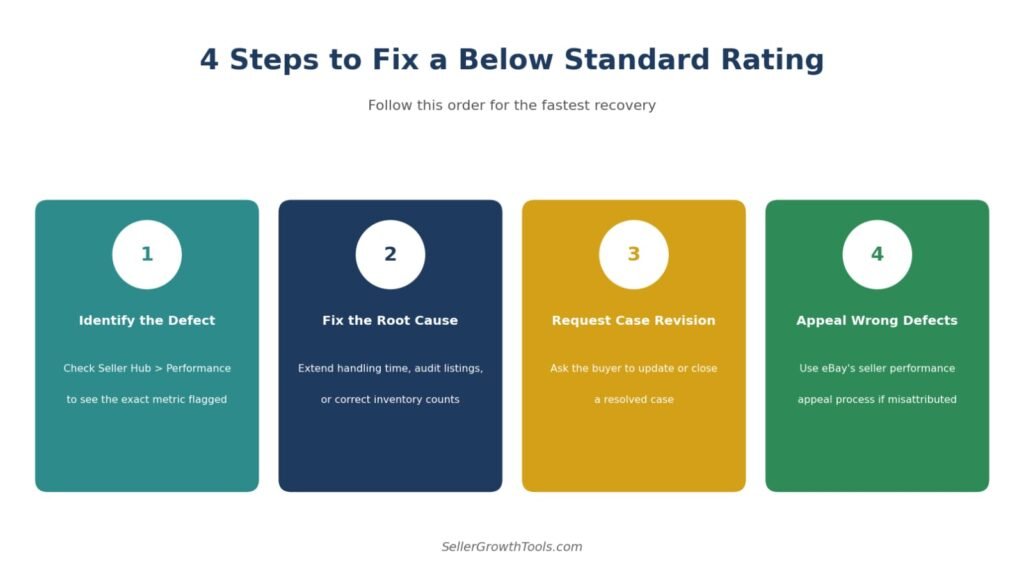
- Identify the exact defect — Seller Hub > Performance shows precisely which metric triggered the rating, so you’re not guessing
- Address the root cause — extend handling time if it’s shipment-related, or audit listing photos and descriptions if it’s item-not-as-described cases
- Request a case revision from the buyer — if you resolved the underlying issue after a case opened, asking the buyer to update or close it can remove the defect
- Appeal defects you believe were misattributed — eBay’s seller performance appeal process exists specifically for cases like buyer-caused cancellations that got marked as seller fault.
How to Prevent It From Happening Again
Set handling times you can actually hit consistently, not just what sounds competitive
Use tracked shipping on every order and confirm it’s actually scanning
Keep inventory counts accurate to avoid last-minute cancellations
Reply to buyer messages within 24 hours
Resolve issues directly with buyers before they escalate into a formal case
Worked Example
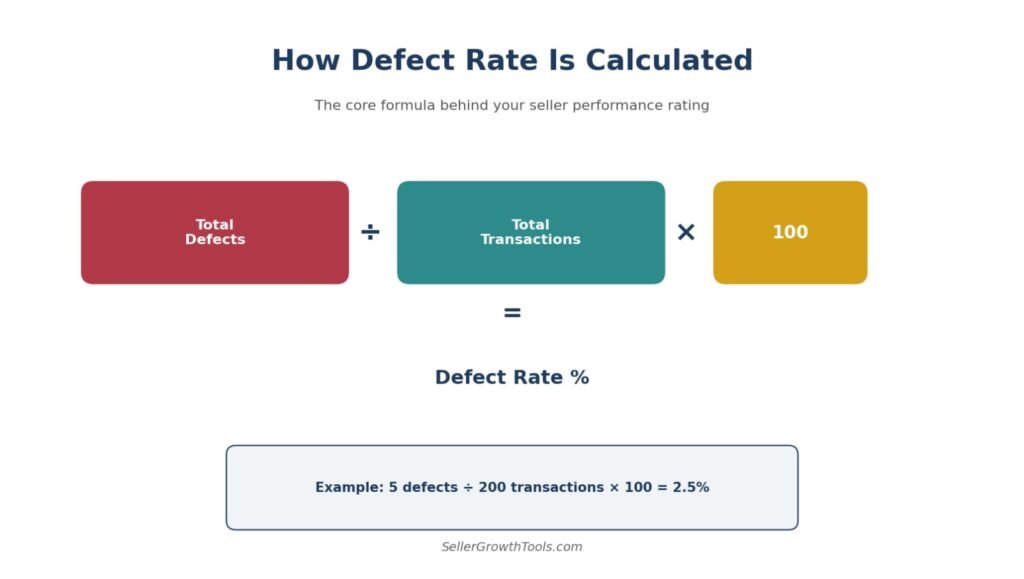
A seller completed 200 transactions over the trailing 3 months. Of those, 5 were cancelled for being out of stock, 3 had item-not-as-described cases that got resolved directly with the buyer, and 2 cases had to be closed by eBay itself.
Defect rate: 5 ÷ 200 = 2.5% — above the 2% threshold, enough on its own to trigger Below Standard
Cases closed without resolution: 2 ÷ 200 = 1% — also above the 0.3% threshold
In this case, the rating traces back almost entirely to inventory accuracy, not shipping speed. The fix isn’t shipping faster — it’s tightening stock counts so cancellations stop happening.
CTA
Curious how a Below Standard rating might affect your actual margins? Run your numbers through our eBay Fee Calculator and eBay ROI Calculator to see where you stand.
Frequently Asked Questions
How long does it take to recover from eBay Below Standard?
Usually one to three monthly evaluation cycles, once the defects causing it stop occurring and older transactions age out of the 3-month window.
Can I appeal a defect?
Yes. eBay’s seller performance appeal process lets you request removal of defects you believe were incorrectly applied, particularly buyer-caused cancellations or cases that were actually resolved.
Does eBay Below Standard affect Managed Payments?
It can, indirectly. Ongoing performance issues can lead to payout holds under Managed Payments, though a single Below Standard rating alone doesn’t automatically freeze your payments.
Does eBay remove defects automatically?
Yes. Most defects age out on their own once they fall outside the rolling evaluation window — 3 months for standard rating, 12 months for Top Rated.
How often does eBay update seller performance?
Roughly once a month, typically around the 20th, though exact timing can shift slightly
Can late shipping defects expire?
Yes, the same way other defects do — they simply age out of the rolling window over time as long as no new ones are added.
What percentage is considered Below Standard?
Generally a defect rate above 2%, a late shipment rate above 5%, or cases closed without resolution above 0.3%. Falling outside any single one of these can trigger the rating.
Will eBay notify me before my account becomes Below Standard?
Usually, yes. eBay tends to send performance alerts and dashboard warnings as your metrics approach the threshold, which gives sellers a chance to course-correct before the official monthly evaluation locks in a Below Standard rating.
Can a single bad transaction cause Below Standard?
For very low-volume sellers, yes — with fewer total transactions, each individual defect carries a lot more percentage weight.
Is Below Standard the same as account suspension?
No. Suspension is a separate and more serious action, generally reserved for repeated or severe policy violations rather than a single performance dip.
Related Guides
The standard you’re working back up towards, and the discount it earns.
What qualifies for removal, and what you’re stuck with.
Cases closed without resolution are the fastest route to a defect.
Late dispatch is a defect — cheaper postage often costs more than it saves.
Where Below Standard goes if it isn’t fixed.
Conclusion
A Below Standard rating feels a lot scarier than it usually is. In almost every case, it’s a fixable, temporary signal tied to a specific, identifiable metric — not a sign your account is in danger. Find the exact defect, fix what’s actually causing it, and give the rolling evaluation window time to catch up. Most sellers are back to Above Standard within a few months without ever seeing a real impact on their ability to sell.
Author Box
Written by Muhammad Usman
eCommerce & SEO Specialist, SellerGrowthTools.com
Muhammad researches and writes eBay, Etsy, and TikTok Shop seller guides for SellerGrowthTools.com, focusing on accurate fee breakdowns and practical tools that help sellers price smarter and grow their business with confidence.
Fact-Checked Box
✓ Fact-Checked — This article was reviewed against eBay’s published Seller Standards policy as of August 2026. Thresholds and evaluation windows may be updated by eBay periodically — always verify current requirements in your Seller Hub before making account decisions.