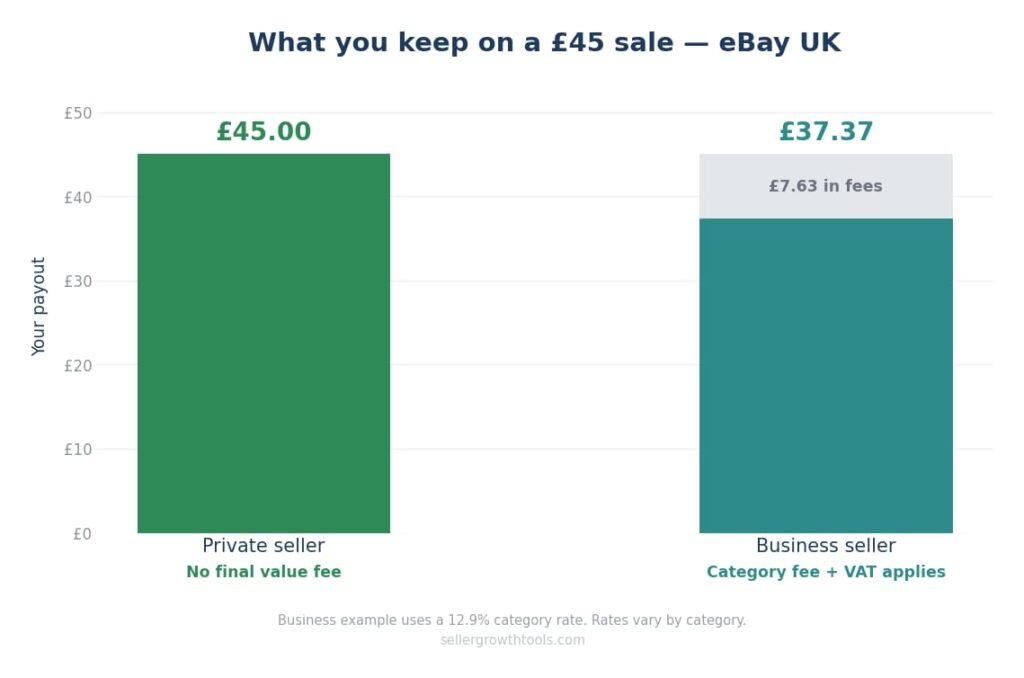
You sell a jacket for £45 on eBay UK. The payout says £45.
Not £39. Not £41.50. Forty-five pounds.
If you’ve sold on eBay before, or you’ve read an American guide about eBay fees, that number looks wrong. It isn’t. eBay private seller fees UK differently from every other major market – Since eBay UK removed selling fees for private sellers, the biggest charge on the platform simply doesn’t apply to you anymore.
This guide covers what that actually means: what you pay now, what the buyer pays instead, where the exceptions are, and the one question that decides whether any of this applies to you at all.
The Short Answer
Quick Answer
Private sellers on eBay UK pay no final value fee on most categories. The charge moved to the buyer instead, in the form of a Buyer Protection Fee paid at checkout.
This applies to private accounts only. Business accounts pay the full category rate plus VAT, exactly as before.
Is It Really No Fees?
This is the question almost everyone arrives with, usually phrased as though they expect to be told there’s a catch.
There is a small one, but it’s smaller than people assume.
What you don’t pay
The final value fee — the percentage eBay takes on every sale — does not apply to private sellers in most categories. This is the charge that costs business sellers anywhere from around 7% to 15% of every transaction, and for private sellers it is simply gone.
What you might still pay
Per-order fee:
Regulatory operating fee:
Insertion fee: only past the monthly free listing allowance
Promoted Listings: only if you choose to use it
eBay UK official Private Seller Fee Page
So What does a sale actually cost?
| On a £45 sale | Private seller | Business seller |
|---|---|---|
| Final value fee | £0.00 | £__ |
| Per-order fee | £__ | £__ |
| Regulatory operating fee | £__ | £__ |
| VAT on fees | £__ | £__ |
| You receive | £__ | £__ |
That gap is the whole story. Same item, same price, same platform — two very different outcomes depending on which account type you hold.
Where the Cost Went: The Buyer Protection Fee
eBay didn’t give up the revenue. It moved it.
Buyers purchasing from private sellers on eBay UK now pay a Buyer Protection Fee at checkout. It sits alongside the item price and postage as a separate line, and it covers eBay’s Money Back Guarantee on that purchase.
It never touches your payout. The buyer pays it, eBay keeps it, and your net figure is unaffected. There is nothing deducted from what you receive.
What it Costs the buyer
The fee is made up of a fixed amount plus a percentage of the item price, so it scales with what the buyer is spending.
| Item price | Buyer Protection Fee | Buyer pays in total |
|---|---|---|
| £10 | £__ | £__ |
| £45 | £__ | £__ |
| £120 | £__ | £__ |
Postage sits on top of that total, and the fee itself doesn’t change whichever postage option the buyer picks.
Rate confirmed on eBay UK’s Buyer Protection page, September 2026.
Why it matters to you anyway
Your payout is unaffected, but your listing isn’t.
A buyer comparing two identical items — one from a private seller, one from a business — sees a higher total at checkout on yours, even if your asking price is lower. Business sellers absorb the fee into their pricing, so their number looks cleaner.
For most casual sales this makes no practical difference. On competitive, price-sensitive items it occasionally does.
Can you cover it for the buyer?
No. It isn’t your fee, so there’s nothing for you to absorb or waive. The only lever you have is your asking price.
Does This Apply to My Category?
Most categories, yes. But not all, and this is where the trading card and fashion sellers usually arrive.
Trading cards, collectables and fashion
These are the three areas where sellers ask most often, partly because they sit on the boundary between hobby selling and actual trading.
The fee position is the same as any other category — private sellers pay no final value fee. What changes is the classification question, which the next section covers, because these are exactly the categories where people sell regularly enough that HMRC and eBay may not see them as private at all.
Where the exemption doesn’t apply
eBay Motors / vehicles — / Property
Category rules change more often than the headline policy does. Confirm your specific category on eBay UK’s official fee page before pricing anything in volume.
Private or Business: The Question That Decides Everything
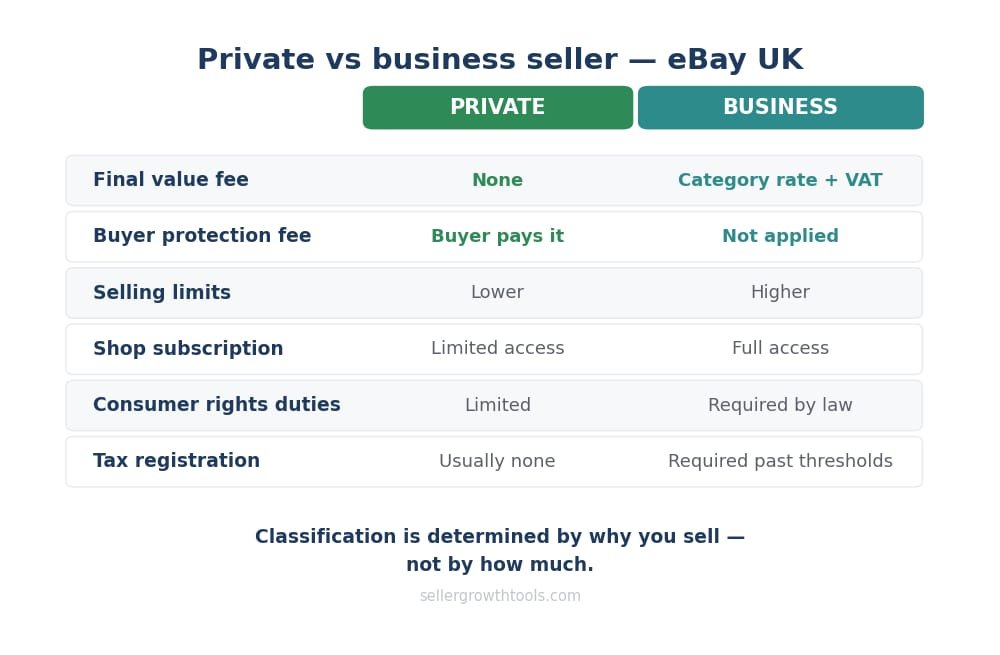
Everything above depends on one thing — that you’re genuinely a private seller.
And because the difference is now the difference between paying nothing and paying double digits, there’s an obvious temptation to stay classified as private for as long as possible. It’s worth being direct about that.
What actually determines it
It isn’t a setting you choose. It’s determined by why you’re selling.
Private means selling things you already owned. Clearing a wardrobe. Selling a games console you’ve upgraded from. Thinning out a collection you built for yourself.
Business means acquiring items in order to sell them. Buying to resell, whether that’s car boot finds, wholesale, retail arbitrage or dropshipping. It doesn’t matter how small the margin is or how part-time it feels.
The test isn’t volume. Someone selling forty personal items over a year is private. Someone selling four items a month that they bought specifically to flip is trading.
The collector edge case
This one is genuinely ambiguous and worth naming.
If you collect trading cards, watches or vintage clothing and periodically sell pieces from your collection, you’re usually still private. If you start buying specifically to resell at a profit — even occasionally, even while keeping some pieces — you’ve moved into trading.
Most people in this position know which side they’re on. If you genuinely don’t, that’s an accountant’s question rather than one to work out from a blog.
Why misclassification is a bad trade
Staying private when you’re actually trading doesn’t just carry a fee risk.
HMRC expects registration once selling becomes a trade rather than occasional personal sales, and the online marketplace reporting rules mean platforms now share seller data with them. eBay also reclassifies accounts itself when activity suggests trading.
The fee saving isn’t worth the exposure. If you’re trading, register as a business and price accordingly.
When It Makes Sense to Switch Anyway
Even with the fee gap, staying private isn’t always the better position.
You’d consider moving to a business account when you’re sourcing to resell rather than clearing personal items, when your selling is approaching the tax reporting threshold, when you want Shop access for the listing allowance, or when private-account selling limits start restricting you.
That last one catches people out. Private accounts have lower limits, and requests to raise them are treated differently. If you’re consistently hitting a ceiling, the fee saving is costing you sales.
Selling limits and how to get them raised: eBay Selling Limits Guide
How the UK Compares
No other major eBay market does this.
| Market | Private seller final value fee |
|---|---|
| United Kingdom | None on most categories |
| United States | Same as business — around 13.6% in most categories |
| Canada | Same as business |
| Australia | Same as business |
If you’re reading American advice about eBay fees and the numbers don’t match your payouts, this is why. Those guides aren’t wrong — they’re just describing a different market.
Full breakdown for both markets: eBay Selling Fees (2026)
Will It Last?
Worth being honest: nobody outside eBay knows.
The policy was introduced to compete with Vinted and Depop, which built their growth on not charging sellers. It’s working in the sense that UK private listing volume has grown. Whether eBay keeps absorbing that cost indefinitely is a commercial decision they haven’t committed to either way.
The practical takeaway: it applies now, so price accordingly now. Don’t build a long-term plan around it continuing, and don’t assume an article you read six months from now is still current. Check the date.
Fact-Checked
Last reviewed: September 2026. Verified against eBay UK’s official seller fee schedule. Fee policies and category exclusions change periodically — confirm your own position on eBay UK’s official fee page before pricing stock. This guide is not tax advice; classification questions should go to HMRC or a qualified accountant.
Frequently Asked Questions
Do UK private sellers really pay no eBay fees in 2026?
No final value fee, which is the charge that matters
Who pays the Buyer Protection Fee?
The buyer, at checkout. It’s separate from the item price and postage, and it doesn’t come out of your payout.
Does the no-fee policy apply to trading cards?
Yes — trading cards follow the same private seller position as other categories. What matters more in that category is whether you’re genuinely selling personally-owned items or buying to resell.
Is it the same for fashion and clothing?
Yes. Clothing is one of the biggest private selling categories on eBay UK and the exemption applies normally.
What if I’m a business seller?
The exemption doesn’t apply. You pay the category final value fee plus VAT on the fee. Full breakdown in our eBay Selling Fees guide.
Can eBay move me to a business account?
Yes. eBay reviews accounts and can reclassify one where activity indicates trading rather than personal selling.
Do I still pay for extra listings?
Only past your monthly free listing allowance. Most private sellers never reach it.
Is this the same on eBay.com?
No. US private sellers pay the same final value fee as business sellers. The UK policy is specific to eBay UK.
Related Guides
The full picture for both UK and US, business and private.
Private accounts have lower limits. How to check and raise yours.
Price your listing against what similar items actually sold for.
Private accounts are held to the same standards. What counts against you.
With no final value fee, postage becomes your largest cost.
Muhammad Usman
eCommerce Specialist · eBay Seller & SEO Expert
Muhammad manages eCommerce operations and SEO for UK sellers across eBay, Etsy, Shopify and TikTok Shop. He built SellerGrowthTools to give sellers the fee and profit numbers they need before they list, not after.
Every guide here is checked against eBay’s current documentation before publishing and revisited when policies change. More about this site · Get in touch