A listing disappears overnight. An email arrives explaining that a rights owner reported it. No advance warning, no chance to respond first. This is how most sellers first encounter eBay VeRO — and the gap between “something happened” and “here’s exactly what to do” is where avoidable mistakes get made.
This guide covers what eBay VeRO actually is, why listings get removed, the different types of infringement, what to do the moment a notice arrives, and how to prevent it from happening again.
What Is eBay VeRO?
VeRO stands for Verified Rights Owner. It is eBay’s intellectual property enforcement system — a formal mechanism that allows brand owners, manufacturers, creators, and their authorized representatives to report eBay listings that infringe their trademarks, copyrights, patents, or design rights.
When a rights owner submits a valid report, eBay removes the listing first and notifies the seller afterwards. There is no advance warning and no negotiation window before the listing comes down. eBay is legally required to act on properly filed infringement notices quickly, which is why the process moves in one direction.
The VeRO participant directory — and why it is not a complete list
eBay publishes a VeRO Participant Profiles directory in Seller Center, organized A to Z by brand name. Each profile is written and managed by the rights owner and typically explains what the brand protects, what restrictions apply, and how to contact their enforcement team.
eBay states clearly that this directory is not a comprehensive list of all brands enrolled in VeRO. Many rights owners participate in the program and actively file reports without having a public profile. Checking the directory and finding no entry for a brand does not mean that brand cannot or will not file a VeRO claim.
Official directory: eBay VeRO Participant Profiles
Why Listings Get Removed — Types of VeRO Infringement
Understanding which type of infringement caused a removal is the first step to knowing what to do next.
Trademark infringement
Using a brand name, logo, or slogan without authorization in a way that suggests affiliation or misleads buyers. This includes using a brand name in the title of an item that brand didn’t manufacture, claiming to be an authorized dealer without documentation, or using phrases like “Gucci-style” or “inspired by Nike.”
Copyright infringement
Using protected content — photographs, product descriptions, marketing text, or artwork — without permission. This is one of the most common causes of VeRO removals, and it frequently catches sellers who copied images from a supplier’s page or a manufacturer’s website. Copyright covers the content regardless of whether it carries a watermark.
Patent and design right infringement
Selling a product that copies a protected invention, mechanical design, or visual design. These reports typically relate to the item itself rather than how it is listed. eBay requires a court order for patent reports in the US, Australia, and Canada.
Unauthorized parallel imports
A genuine product sold into a market where the brand has not authorized its sale. The legal mechanism is regional exhaustion of trademark rights. UK sellers should note that post-Brexit, the UK operates its own exhaustion regime separately from the EU.
Other IP violations
Including misrepresented warranty terms — stating a manufacturer warranty applies when it doesn’t survive resale — and regulated or recalled products where restrictions apply beyond standard IP law.
Content Issue vs Product Issue — A Critical Distinction
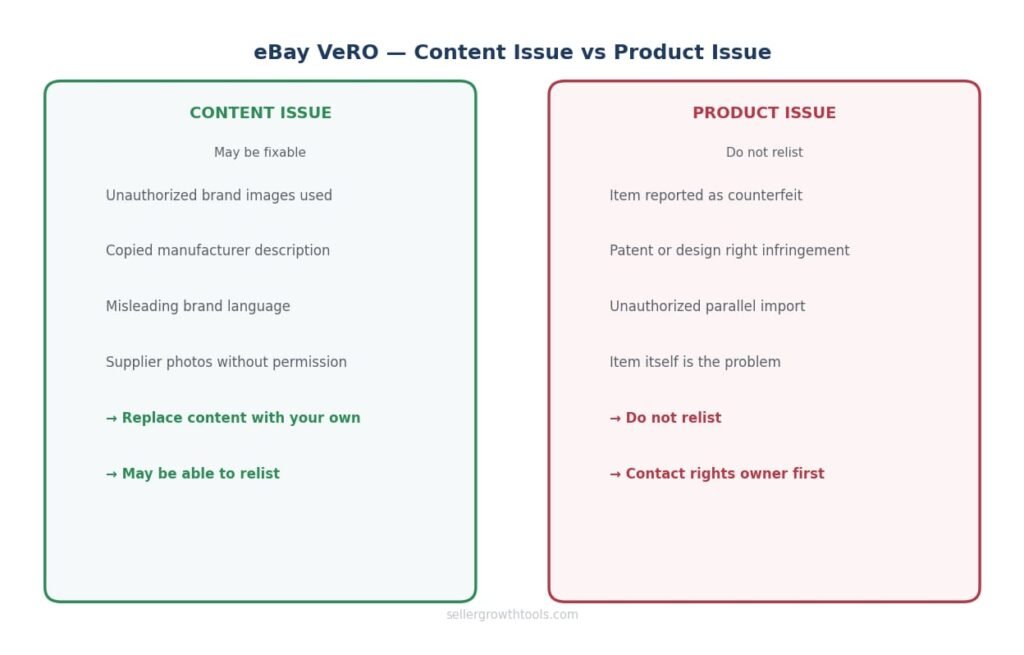
If the problem is how the item was listed — unauthorized images, copied text, misleading brand claims — you may be able to edit and relist the item once the infringing content is corrected. If the problem is the item itself — counterfeit goods, patent infringement, a region-restricted parallel import — relisting is not appropriate. eBay explicitly states that an item reported as allegedly counterfeit should not be relisted; doing so can lead to further restrictions or suspension.
Listing content issue — may be fixable
A genuine product listed using the brand’s copyrighted images, copied manufacturer descriptions, or misleading brand language is a content issue. Once the infringing content is removed and replaced with original material, you may be able to relist — but follow the instructions in your specific removal notice, as eligibility varies.
Product issue — relisting not appropriate
If the removed listing was reported as counterfeit, or the item itself infringes a patent or registered design, correcting the listing content will not resolve the underlying problem. Do not relist. Contact the rights owner or seek appropriate advice before taking any further action.
What to Do When You Receive a VeRO Notice
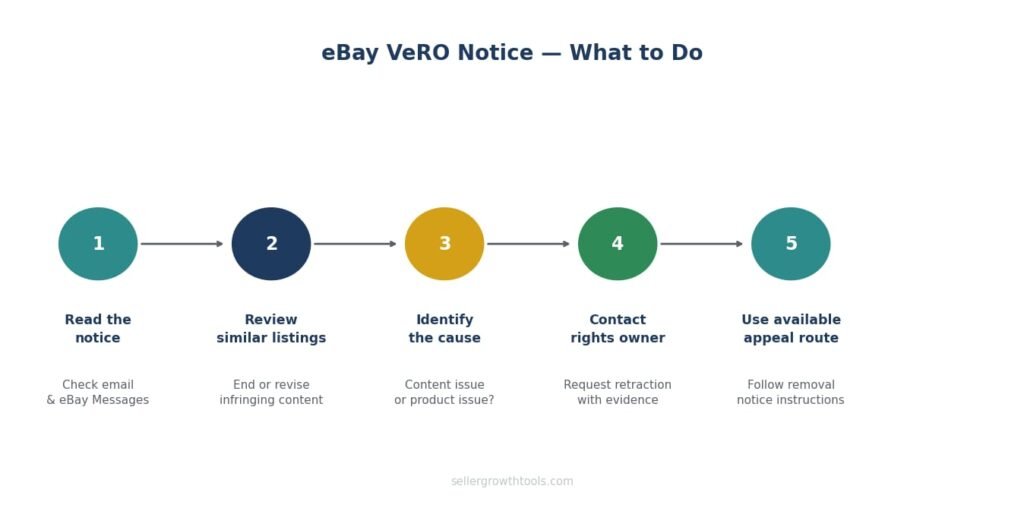
Step 1 — Read the notice carefully
eBay sends the notice to your registered email address and to My eBay Messages. It names the rights owner, gives their contact information, states the type of infringement reported, and sets out what options are available to you. Read it in full before doing anything else — the notice itself tells you what steps apply to your situation.
Step 2 — Review similar listings
Review any other listings that contain the same potentially infringing content or the same product type. End or revise any that carry the same issue — but note that similar listings are not automatically infringing. Assess each one on its own merits.
Step 3 — Identify what caused the removal
Content problem (images, text, brand language) → you may be able to revise and relist. Follow your removal notice instructions.
Product problem (counterfeit, patent, parallel import) → do not relist. Contact the rights owner or seek advice first.
Step 4 — Contact the rights owner
The removal notice includes the rights owner’s contact details. If you believe the report was made in error — for example, you are an authorized reseller with documentation — contact them professionally with your evidence. Keep the message factual: your eBay user ID, the removed item numbers, where you sourced the product, and any authorization documentation you hold.
If the rights owner agrees the report was mistaken, they must submit a retraction themselves from an authorized email address. eBay will not reverse the removal based on your account alone.
Step 5 — Use available appeal routes
The routes available to you depend on your situation. eBay UK’s guidance for sellers outlines the options: you can follow the instructions in the removal notice, file an appeal where that option is available, request a retraction from the rights owner, or provide authorization evidence to eBay’s VeRO support team. The removal notice will indicate which routes apply to your specific case.
Official policy: eBay UK Intellectual Property Policy
Common Categories Where Sellers Should Check IP Rights
No article can provide a complete or current list of every brand enrolled in VeRO — eBay itself does not publish one. The following are categories where IP enforcement is particularly active, and where checking the VeRO directory and any available brand profile before listing is especially important.
Electronics and technology
Phone accessories, audio equipment, cameras, and computing products are among the most reported categories. Compatibility language matters here — “compatible with [Brand]” on a product specifically designed for that brand is permitted; using a brand name on a genuinely universal item is not.
Fashion and luxury goods
Clothing, footwear, accessories, and handbags — particularly any involving luxury brands. Enforcement in this category is typically thorough, and authorized resale conditions vary significantly by brand.
Entertainment and licensed merchandise
Character merchandise, gaming products, sports licensing, film and music branding. Licensed merchandise requires the correct authorization from the licence holder, not just the manufacturer.
Health, beauty, and regulated products
Professional product lines, medical devices, regulated supplements, and beauty equipment. Some products in this category carry restrictions beyond IP law — including recall or safety restrictions.
Automotive parts and accessories
Fitment listings — parts compatible with multiple manufacturers — frequently trigger trademark issues when brand names are stacked in titles. eBay’s guidance is to use one brand name in the title and reference others with “fits” or “for” in the description.
How to check before listing
Before listing any product associated with a recognizable brand:
- Check the VeRO Participant Profiles directory for a profile
- Read the profile in full if one exists
- Verify with your supplier whether you are authorized to resell
- Remember: no profile in the directory does not mean no VeRO risk
What If You Are a Legitimate Seller Wrongly Reported?
Authorized resellers and sellers of genuine goods do receive VeRO notices — sometimes because of a content issue on an otherwise legitimate listing, sometimes because of an erroneous report.
If you have authorization
Gather your documentation: invoices showing purchase from an authorized distributor, any brand authorization letter or reseller agreement, and evidence the item is genuine. Contact the rights owner with this documentation and request a retraction. If they agree the report was made in error, the retraction must come from them.
If the report was about listing content, not the product
Revise the content — replace their images with your own, rewrite the description in original language, remove any unauthorized brand claims — and follow the instructions in your removal notice about whether and how to relist. The product itself was not the issue.
If you receive no response from the rights owner
If you contact the rights owner and receive no reply after a reasonable period, you can escalate through eBay’s available appeal routes with your documentation. eBay UK’s seller guidance outlines what evidence eBay’s VeRO support team can consider.
US Copyright Claims and the DMCA Counter Notice
This option applies only to US copyright claims and does not extend to trademark, patent, or design right violations.
What a DMCA counter notice is
If your listing on ebay.com was removed because of a US copyright claim and you believe the claim was incorrect, you may be able to file a DMCA counter notice. Under the US DMCA framework (Section 512(g)), Under the US DMCA framework (Section 512(g)), after a compliant counter notice is received, the platform is required to restore the material unless the original claimant notifies the platform of a court action. For eBay specifically, its current US guidance states that the listing will be reinstated after 10 business days if the VeRO participant does not notify eBay that it has filed an action seeking a court order.
Important limitations
- This applies only to US copyright claims on ebay.com listings
- It does not apply to trademark, patent, or design rights reports
- It does not apply to listings on eBay UK, eBay Germany, or other non-US sites
- Filing a counter notice is a legal action carrying personal responsibility
- Take legal advice before filing if you are unsure
UK sellers and copyright claims
UK copyright law operates under the Copyright, Designs and Patents Act 1988 rather than the DMCA. The counter notice process described above is not available for UK copyright claims. If your UK listing was removed for copyright reasons, the routes available are contacting the rights owner directly or using eBay’s appeal process as outlined in your removal notice.
UK vs US — Key VeRO Differences
| UK Sellers | US Sellers | |
|---|---|---|
| Copyright law | CDPA 1988 | DMCA |
| DMCA counter notice | Not available | Available for copyright claims only |
| Parallel imports | Post-Brexit UK exhaustion regime | US exhaustion rules apply |
| VeRO directory | eBay UK Seller Centre | eBay US Seller Center |
| Patent reports | Standard VeRO process | Court order required (US, AU, CA) |
| Appeal process | Follow removal notice instructions | Follow removal notice instructions |
Can a VeRO Violation Restrict or Suspend Your eBay Account?
Yes — repeated IP violations can escalate to account restrictions and permanent suspension. eBay does not publish a fixed rule about exactly how many violations trigger which consequence. What eBay states is that consequences escalate with repeated violations, from warnings through selling restrictions to permanent account suspension.
A first violation typically results in the listing removal and a notice. Acting on it promptly — reviewing and revising similar content, not relisting a reportedly counterfeit item, addressing the underlying cause — is the most important response.
VeRO violations are separate from your transaction defect rate. A VeRO removal does not automatically add to the defect rate metric tracked in your Seller Performance dashboard. Account consequences from IP violations operate through a different track from transaction performance metrics.
For how transaction defects work: eBay Seller Performance Guide
If your account has already been restricted: eBay Account Suspended
If you have received an MC999 account restriction notice: eBay MC999 Guide
How to Prevent VeRO Violations
Use your own images
Take your own photographs of the product, or use images your supplier has explicitly authorized. Images from brand websites, manufacturer catalogues, and third-party sources are not yours to use without permission.
Write original descriptions
Even when a supplier’s description is accurate, copying it wholesale copies the copyright too. eBay’s guidance is clear that sellers should not copy text from manufacturer websites or other third-party sources without permission. Write in your own words.
Use brand names correctly
You may use a brand name in a listing when that brand genuinely made the item. For compatible or replacement products, use “for,” “fits,” or “compatible with” in front of the brand name. eBay specifically recommends this approach for genuine products where brand names are needed to describe compatibility.
Do not claim authorized dealer status you do not have
Do not describe yourself as an authorized dealer or reseller if you are not one. eBay specifically instructs sellers not to create the impression of an unauthorized dealer or reseller relationship.
Do not misrepresent warranty terms
If the manufacturer warranty does not transfer on resale, do not state that it does. Offer your own guarantee if you want to include one, stated clearly as your own.
Check the VeRO directory before listing branded items
If a brand has a participant profile, read it before listing. It usually explains what the brand permits and prohibits for sellers. Remember that no profile does not mean no risk.
Source carefully
A supplier who cannot provide invoices from a legitimate distributor, authorization documentation, or clear evidence of genuine goods is a risk. For branded items, documentation is what protects you if a report arrives.
Frequently Asked Questions
What is eBay VeRO?
VeRO stands for Verified Rights Owner. It is eBay’s system allowing intellectual property owners — brands, manufacturers, creators, and their authorized representatives — to report listings that infringe their trademarks, copyrights, patents, or design rights.
What happens when eBay receives a VeRO report?
If the report is valid and complete, eBay removes the listing and notifies the seller. This happens without advance warning. The seller can then follow the instructions in the removal notice, which may include options to contact the rights owner, appeal, or revise and relist depending on the type of infringement.
Can I relist after a VeRO removal?
It depends on what was reported. If the problem was listing content — images, text, brand language — you may be able to revise and relist once the infringing content is corrected. Follow your specific removal notice instructions. If the item itself was reported as counterfeit or infringing a patent or design right, do not relist.
How do I find out which brands are on the VeRO list?
Check eBay’s VeRO Participant Profiles directory in Seller Center. Note that this is not a complete list — many rights owners participate in VeRO without publishing a public profile.
Can I appeal a VeRO removal?
Yes, in many cases. The available routes depend on your situation and are outlined in your removal notice. Options may include contacting the rights owner for a retraction, filing an appeal where available, or providing authorization evidence to eBay’s VeRO support team. For US copyright claims specifically, a DMCA counter notice may also be an option.
Does VeRO cover pricing restrictions or MAP policies?
No. VeRO handles intellectual property only. Minimum advertised pricing, selective distribution agreements, and resale price restrictions fall outside VeRO’s scope.
Will a VeRO violation affect my defect rate?
VeRO violations operate separately from your transaction defect rate metric. Repeated violations can lead to account restrictions and suspension through eBay’s IP enforcement track, which is distinct from the seller performance defect rate.
What is the difference between a VeRO violation and an MC999 restriction?
A VeRO violation is a specific intellectual property report against a listing. An MC999 restriction is an account-level restriction that can arise from various causes, including repeated policy violations. Repeated VeRO violations can contribute to account-level action. See our MC999 guide for the full account restriction process.
Related Guides
Account-level restrictions that can follow repeated policy violations — what they mean and what to do.
When escalating violations lead to suspension — causes, appeal routes and what actually works.
How eBay measures account health — and how IP violations differ from transaction defects.
How to write listings that rank well and stay compliant — brand names, compatibility language, and more.
Managing buyer feedback alongside listing compliance for a clean seller account.
Muhammad Usman
eCommerce & SEO Specialist
Muhammad manages eCommerce operations and SEO for UK sellers across eBay, Etsy, Shopify and TikTok Shop. He built SellerGrowthTools to give sellers the fee and profit numbers they need before they list, not after.
Every guide here is checked against eBay’s current documentation before publishing and revisited when policies change. More about this site · Get in touch