Quick Answer: Yes, eBay drop shipping is allowed on eBay — but only under specific conditions. eBay permits sourcing from wholesalers, manufacturers, and legitimate distributors who agree to ship on your behalf. What eBay does not allow is retail arbitrage — buying an item from another retail marketplace (like Amazon or Walmart) and having it shipped directly to your eBay buyer without disclosure. Get this distinction wrong and you risk listing removals, account restrictions, or a Below Standard rating from late or inconsistent shipping.
Key Takeaways
Dropshipping is allowed only from wholesale/manufacturer sources — not from other retail marketplaces
Retail arbitrage (Amazon-to-eBay without disclosure) clearly violates policy and can get listings removed
AliExpress and DHgate sit in a grey area — not explicitly banned, but not officially compliant wholesale sourcing either
Supplier reliability directly affects your Seller Standards — late shipments from a supplier still count as your defect
Profit margins on dropshipped items are usually thinner than sourced inventory once all fees are factored in — always calculate before listing.
Table of Contents
- Is eBay Drop shipping Allowed in 2026?
- What Is eBay Drop shipping?
- eBay Dropshipping vs Retail Arbitrage
- Suppliers: Compliant, Grey Area, and Not Allowed
- How Dropshipping Affects Your Seller Performance Standards
- Step-by-Step: How to Start Legitimate eBay Dropshipping
- Calculating Real Profit on a Dropshipped Item
- Pros and Cons of eBay Dropshipping in 2026
- Country-Specific Notes
- Frequently Asked Questions
- Related Guides
Dropshipping gets talked about like it’s either a golden ticket or a policy violation waiting to happen, and honestly, both reputations have some truth to them. The real answer sits in the middle: eBay allows dropshipping, but only when it’s done a specific way, and a lot of sellers get tripped up by not knowing exactly where that line is.
This guide walks through eBay’s actual policy in plain language, which suppliers keep you compliant versus which ones carry real risk, and — just as importantly — what the real numbers look like once you factor in every fee. A lot of dropshipping guides skip that last part entirely, and it’s usually the difference between a profitable side business and a seller wondering where their margin went.
Is eBay Drop shipping Allowed in 2026?
Short answer: yes, with conditions. eBay’s official policy permits dropshipping specifically when a seller sources inventory from a wholesale supplier, manufacturer, or legitimate distributor who has agreed to fulfill orders on the seller’s behalf.
What’s allowed:
Sourcing from wholesale suppliers or manufacturers with a documented business relationship
Using a supplier agreement or partnership where the supplier ships under your business identity or with appropriate packaging
Maintaining full control over customer service, returns, and buyer communication yourself
What’s not allowed — retail arbitrage risks:
Buying an item from another online retailer (Amazon, Walmart, Target) and having it shipped directly to the eBay buyer
Shipping arrives with the original retailer’s packing slip, invoice, or branding, exposing that the item wasn’t sourced the way the listing implies
No control over stock levels, pricing changes, or shipping timelines set by a retailer that has no idea you’re reselling their inventory
Supplier agreement requirement:
eBay expects a seller to have an actual sourcing relationship with their supplier — not simply reselling whatever’s cheapest on another platform at the moment of sale. This matters more than most sellers realize, because it’s the difference between “supply chain” and “arbitrage” in eBay’s eyes.
What Is eBay Drop shipping?
At its core, drop shipping means you list and sell an item on eBay without holding the inventory yourself. When an order comes in, you purchase the item from your supplier, who ships it directly to your customer. You never touch the product — you’re managing the sale, pricing, and customer experience while your supplier handles fulfillment.
The model itself isn’t controversial. Traditional wholesale drop shipping has existed for decades and works fine within eBay’s rules. The controversy comes entirely from how some sellers source their inventory, which brings us to the next section.
eBay Drop shipping vs Retail Arbitrage
This is the single most important distinction in this entire guide, so it’s worth spelling out clearly.
| Compliant Dropshipping | Retail Arbitrage | |
|---|---|---|
| Source | Wholesale supplier or manufacturer | Another retail marketplace (Amazon, Walmart, Target) |
| Supplier Relationship | Documented agreement, supplier knows you’re reselling | None — retailer has no idea you’re reselling |
| Packaging | Neutral or business-branded packaging | Original retailer’s packing slip/invoice often included |
| Stock Control | Negotiated stock levels and pricing | No control — retailer can change price/stock anytime |
| eBay Policy Status | ✓ Allowed | ✗ Not Allowed |
Compliant drop shipping involves a real business relationship with a supplier who knows you’re reselling their product and ships accordingly — often with neutral packaging, consistent stock, and negotiated pricing.
Retail arbitrage means buying from a consumer-facing retailer at retail price and reselling on eBay for a markup, with the retailer shipping directly to your buyer. The retailer has no idea their customer is actually an eBay reseller, and packaging often gives this away — a customer expecting a package from a small eBay seller instead receives a box from a major retailer with their invoice inside.
eBay has increasingly scrutinized this pattern because it creates a poor buyer experience (unpredictable shipping times tied to a third-party retailer’s fulfillment, not yours) and opens the door to pricing and stock mismatches that lead to cancelled orders — which, worth noting, directly damages your defect rate.
Suppliers: Compliant, Grey Area, and Not Allowed
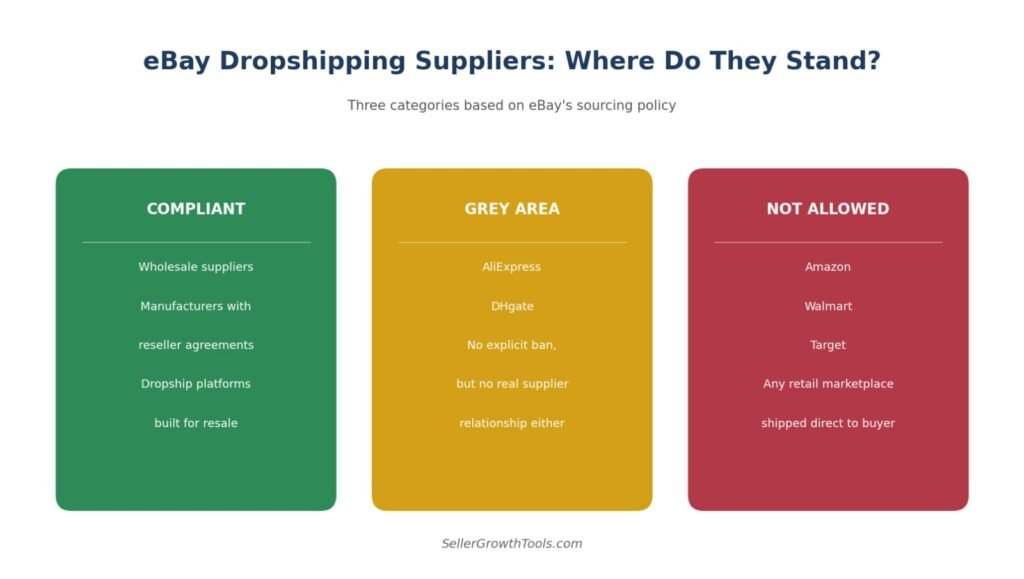
Compliant Sources
Wholesale suppliers with a formal account setup (many require a business license or resale certificate)
Manufacturers willing to drop ship directly under a reseller agreement
Established dropshipping platforms designed specifically for marketplace resale (not general retail sites).
High Risk / Grey Area Sources
AliExpress and DHgate — eBay’s policy doesn’t explicitly name these as “not allowed” the way it does with retail marketplaces like Amazon, which is exactly why they sit in a genuine grey area. They’re consumer-facing marketplaces, and using them for direct-ship dropshipping without a real supplier relationship carries meaningful risk even without an explicit ban. Many sellers use them, but enforcement can tighten without notice, and buyers can be put off by shipping times or packaging that doesn’t match the listing.
Not Allowed Sources
Amazon, Walmart, Target, and other retail marketplaces — clearly against eBay’s policy when used as a direct-ship source
The safest long-term move is building an actual relationship with a wholesale supplier — even a small one — rather than relying entirely on grey-area or non-compliant sourcing that can become a real problem the moment eBay tightens enforcement.
How eBay Drop shipping Affects Your Seller Performance Standards
This connects directly to something a lot of dropshipping guides don’t mention: your supplier’s reliability becomes your problem the moment you dropship.
If your supplier ships late, eBay counts that against your late shipment rate — not theirs. If your supplier runs out of stock after you’ve already listed and sold the item, that cancellation counts as a defect on your account. This is one of the most common ways dropshippers accidentally end up with a Below Standard rating, because they assume supplier delays are somehow separate from their own performance metrics. They’re not.
For a full breakdown of how these thresholds work and what happens if you fall below them, see our eBay Below Standard Rating Guide — it’s essential reading before you scale any dropshipping operation, since the metrics that trigger a rating drop are exactly the ones dropshipping tends to strain. Understanding your current standing also matters if you’re aiming for Top Rated Seller status down the line, which becomes much harder with inconsistent supplier-driven shipping.
Step-by-Step: How to Start Legitimate eBay Drop shipping
- Research your niche and confirm real demand — check sold listings and sell-through rates before committing to a product category
- Find a compliant wholesale supplier — prioritize ones with consistent stock, reasonable shipping times, and a real business relationship, not just the lowest price
- Set up your eBay seller account and understand your starting selling limits
- List with accurate handling times based on your supplier’s actual shipping speed, not an optimistic guess
- Price with every fee factored in — final value fee, supplier cost, supplier shipping, and payment processing, not just supplier cost plus a markup. See our eBay Selling Fees 2026 guide for the full current fee breakdown
- Monitor your Seller Standards dashboard regularly, since supplier issues show up there before they become a real problem
Calculate Your Real eBay Dropshipping Profit
Use our free eBay Fee Calculator and eBay ROI Calculator before listing any product.
Calculating Real Profit on a Dropshipped Item
Dropshipping margins tend to look better on paper than they turn out in practice, mostly because sellers forget to stack every fee before calling a price “profitable.”
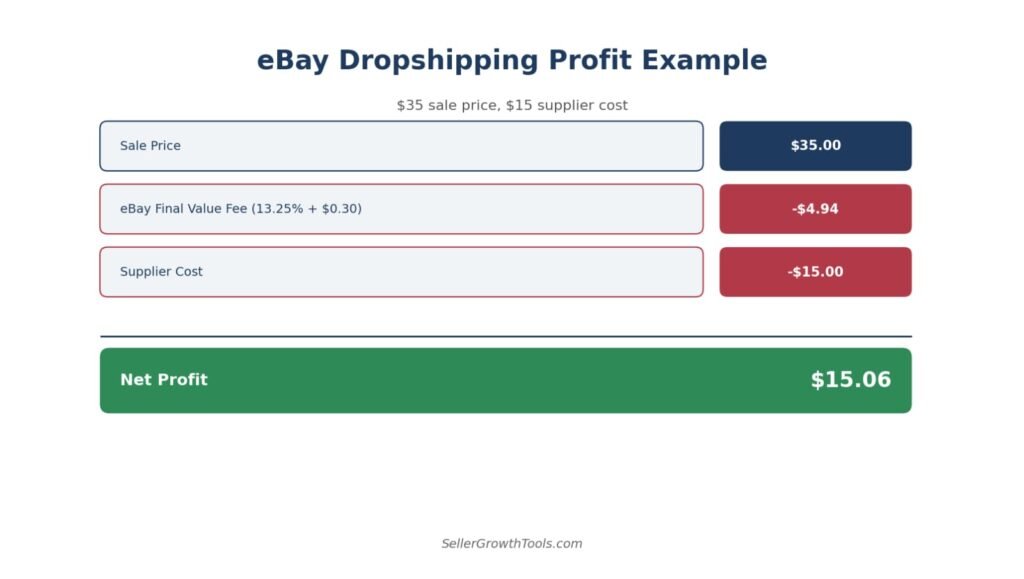
Worked example:
An item costs $15 from your wholesale supplier, including their shipping to you or direct-to-buyer. You list it on eBay for $35.
eBay final value fee (approx. 13.25% + $0.30): -$4.94
Supplier cost: -$15.00
Payment processing (already included in final value fee under Managed Payments in most cases)
Net profit: $35 – $4.94 – $15.00 = $15.06 (shown as ~$15 in the accompanying infographic)
That looks solid until you factor in returns, any Promoted Listings ad spend if you’re using them, and the reality that dropshipping prices often need to stay competitive with sellers who source in bulk at lower unit costs. The margin compresses fast.
This is exactly why running your numbers through a calculator before listing matters more in dropshipping than in almost any other selling model — there’s no bulk discount cushioning a pricing mistake.
Pros and Cons of eBay Drop shipping in 2026
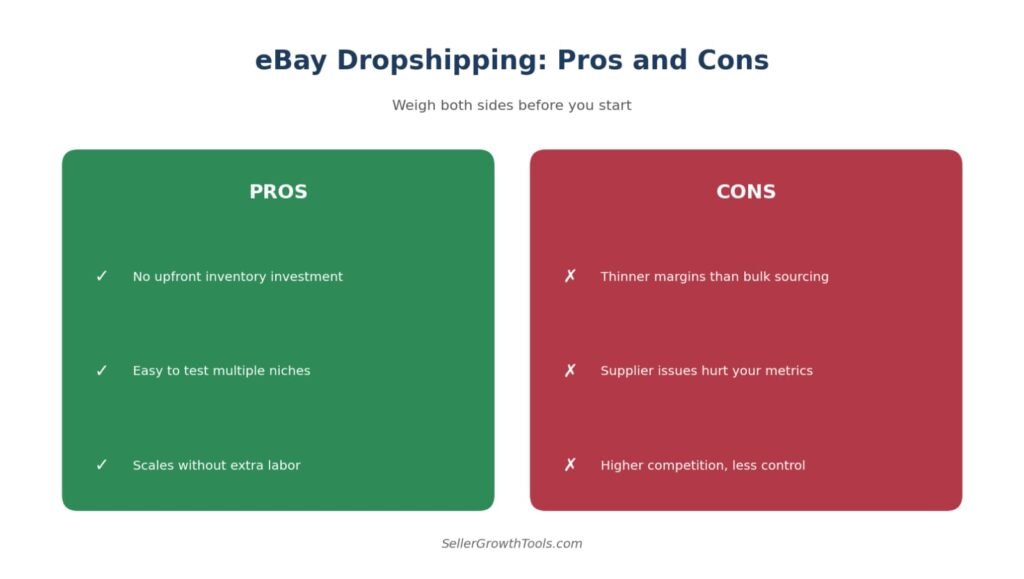
Pros:
No upfront inventory investment or storage space needed
Easy to test multiple products or niches without financial risk
Scales without needing to physically handle more orders yourself
Cons:
Thinner margins than sourced or bulk inventory
Supplier reliability directly impacts your seller performance metrics
Higher competition on popular dropshipped items, since low barrier to entry means many sellers list the same products
Less control over shipping speed and packaging quality, both of which shape buyer experience and reviews.
Country-Specific Notes
United States
Standard eBay policy applies. No special dropshipping restrictions beyond the general wholesale-vs-arbitrage rule.
United Kingdom
VAT registration may be required depending on sales volume — factor this into pricing, since it directly affects your real margin on every dropshipped sale.
Canada
Cross-border dropshipping (US-based suppliers shipping to Canadian buyers) adds customs and duty considerations that can extend delivery times — build extra handling time buffer to avoid late shipment defects.
Australia
GST registration thresholds apply similarly to VAT in the UK. Long shipping distances from overseas suppliers make accurate handling time estimates especially important here.
Frequently Asked Questions
Is eBay drop shipping legal?
Yes, dropshipping itself is a legal business model. What matters is compliance with eBay’s specific policy on sourcing — wholesale and manufacturer sourcing is compliant, retail arbitrage is not.
Is Amazon to eBay drop shipping allowed?
No. Sourcing from Amazon and shipping directly to an eBay buyer violates eBay’s dropshipping policy and can result in listing removal or account action.
Can beginners start eBay drop shipping?
Yes, it’s often recommended as a low-capital way to start selling, but beginners should prioritize finding a compliant supplier over chasing the lowest possible cost, since supplier reliability directly affects account health from day one.
Do I need an LLC for eBay drop shipping?
Not strictly required to start, but many wholesale suppliers require a business license or resale certificate to open an account, which often means forming a basic business entity earlier than sellers expect.
Is drop shipping still profitable in 2026?
Yes, but margins are tighter than they were several years ago due to increased competition and rising marketplace fees. Profitability now depends heavily on supplier relationships and accurate fee calculation rather than simply finding a trending product.
What is eBay’s official policy on drop shipping?
eBay permits drop shipping from wholesale suppliers and manufacturers but prohibits sourcing from other retail marketplaces where the item ships directly from that retailer to the eBay buyer.
Can I use Ali Express for eBay drop shipping?
It’s widely used but sits in a grey area rather than being clearly compliant or explicitly banned. It carries real risk since it isn’t officially considered wholesale sourcing under eBay’s policy.
How do I find a wholesale supplier for eBay drop shipping?
Wholesale directories, manufacturer trade shows, and direct outreach to manufacturers in your chosen niche are more reliable long-term than relying solely on marketplace sourcing.
CTA
Before you list your next drop shipped item, run the numbers. Use our free eBay Fee Calculator and eBay ROI Calculator to see your real profit margin after every fee — not just the markup.
Conclusion
eBay drop shipping works when it’s built the right way — real supplier relationships, honest handling times, and margins that are calculated rather than guessed. The sellers who run into trouble almost always trace it back to the same root cause: sourcing from another retailer instead of an actual wholesale supplier. Get that part right, keep your numbers honest, and drop shipping remains a legitimate, sustainable way to sell on eBay in 2026.
Author Box
Muhammad Usman
Founder of SellerGrowthTools — building free, accurate calculators and plain-English guides for eBay, Etsy, and TikTok Shop sellers. Every article is researched against official platform policies and updated regularly to reflect current fee structures.
Fact-Checked Box
✓ Fact-Checked — This article was reviewed against eBay’s published dropshipping and seller policies as of August 2026. Rules and enforcement may change over time — always verify current requirements in your Seller Hub before sourcing or listing products.
Official eBay drop shipping policy page:
Related Guides
Dropshipping margins are thin — check the numbers before you list.
Policy-breaking dropshipping is a common suspension trigger.
Find products with real demand instead of guessing from supplier catalogues.
Returns are far harder when the stock never passed through your hands.
Scaling fast hits limits fast — know how they’re raised.