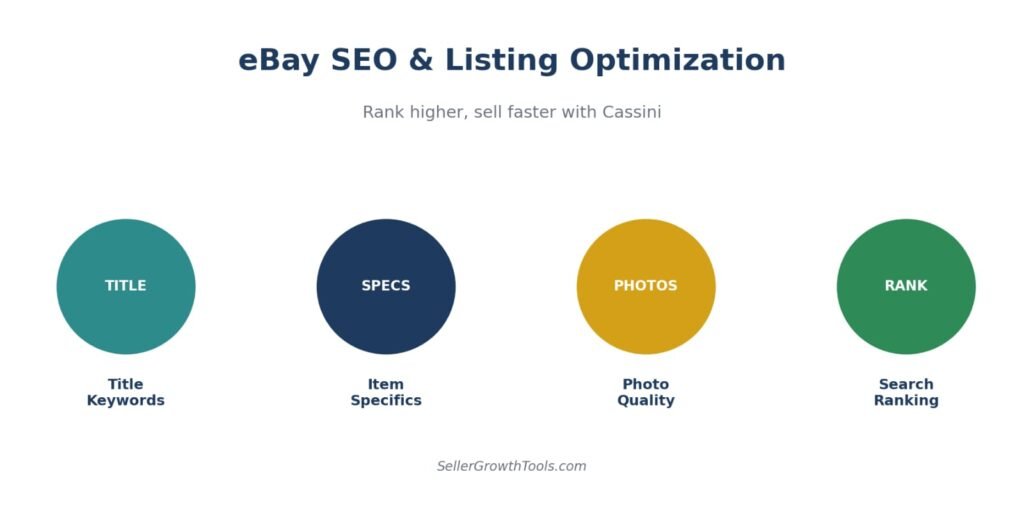
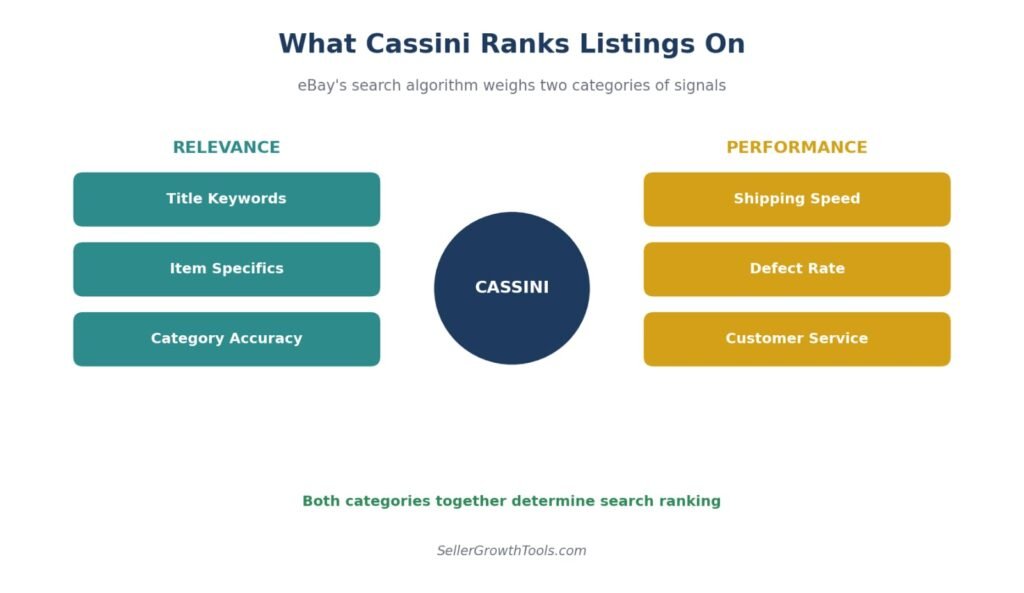
Quick Answer: eBay SEO means optimizing your listings so they rank higher in eBay’s own search results, powered by an algorithm called Cassini. Cassini ranks listings based on relevance (title keywords, item specifics, category accuracy) and seller performance (shipping speed, defect rate, customer service). The fastest wins are a keyword-rich title, fully completed item specifics, high-quality photos, and competitive pricing — none of which require paid advertising.
Key Takeaways : eBay’s search algorithm (Cassini) ranks listings on relevance plus seller performance, not just price
Title keywords and complete item specifics are the two highest-leverage, lowest-effort fixes
Seller performance directly affects ranking, not just buyer trust
Promoted Listings can boost visibility but doesn’t replace organic optimization
Photos and price competitiveness both influence click-through, which feeds back into ranking.
Table of Contents
What Is eBay SEO?
How eBay’s Search Algorithm (Cassini) Works
Title Optimization
Item Specifics — Why They Matter
Photos & Listing Quality
Price Competitiveness
Seller Performance’s Impact on Ranking
Promoted Listings vs Organic Ranking
Common Listing Mistakes
eBay SEO Checklist
Frequently Asked Questions
Related Guides
Two sellers can list the exact same product, at the exact same price, and still get completely different amounts of traffic — because one of them is optimized for eBay’s search algorithm and the other is guessing. eBay SEO isn’t a mysterious black box; it’s a set of specific, learnable factors that determine which listings surface first when a buyer searches.
This guide breaks down exactly how eBay’s search algorithm works and gives you a practical checklist to apply to every listing you create.
What Is eBay SEO?
eBay SEO is the practice of optimizing your listings — titles, item specifics, photos, pricing, and overall seller performance — so they rank higher in eBay’s internal search results. Unlike Google SEO, there’s no backlink profile or domain authority involved; everything that affects your ranking happens inside your own eBay account and listings, which means it’s entirely within your control.
How eBay’s Search Algorithm (Cassini) Works
Most listing advice tells you what to change. It helps to know what you’re changing it for.
Cassini is the name of eBay’s search engine. It replaced the older Voyager system and works on a different principle: instead of matching keywords and sorting by listing time, it tries to predict which listing is most likely to end in a completed sale. eBay’s own documentation on how search works is worth reading directly, though it’s deliberately light on specifics: eBay’s Best Match guidance.
That distinction matters more than it sounds. Cassini isn’t asking which listing mentions a keyword most often. It’s asking which listing this particular buyer will actually purchase.
Best Match is what you see, Cassini is what decides it
Buyers see a dropdown labelled Best Match — that’s the default sort order on every eBay search.
Cassini is the engine behind it. When sellers say “my listing dropped in Best Match”, what’s actually changed is how Cassini scored that listing against everything else competing for the same search.
What Cassini weighs
eBay has never published the full list or the weightings, and anyone quoting exact percentages is guessing. What’s reasonably established from eBay’s own documentation and seller observation:
Relevance. How well your title and item specifics match what was typed. This is the entry ticket — get it wrong and nothing else matters.
Listing quality. Photo count, description completeness, how many item specifics are filled in. Half-finished listings sit below complete ones.
Seller performance. Defect rate, late shipment rate and tracking validation all feed in at account level, not listing level.
Buyer behaviour. Click-through rate, watchers, and sell-through on similar items. Listings people actually click and buy get shown more often.
Price competitiveness. The cheapest doesn’t automatically win, but a listing priced well above comparable sold items gets less visibility.
Postage terms. Free or fast dispatch tends to help. Long handling times tend not to.
The part sellers underestimate: seller performance is a ranking factor, not just an account status. A perfectly optimised listing on a Below Standard account will still sit below a mediocre listing on a Top Rated one.
What you control and what you don’t
In your control: title, item specifics, photos, description, price, postage terms, handling time, returns policy, and your seller metrics.
Not in your control: the buyer’s search history, their location, what else is listed at that moment, and eBay’s own weighting changes.
Which is why chasing the algorithm rarely works. Sellers who rank consistently aren’t gaming anything — they’re filling in item specifics properly, dispatching on time, and keeping their metrics clean.
Why the same search shows different results
Cassini personalises. Two buyers searching the same term at the same moment can see different orderings based on location, past behaviour and device.
This is worth knowing because sellers check their own listing position constantly and draw conclusions from it. What you see isn’t what everyone sees, and it isn’t a reliable measure of where you actually rank.
Title Optimization
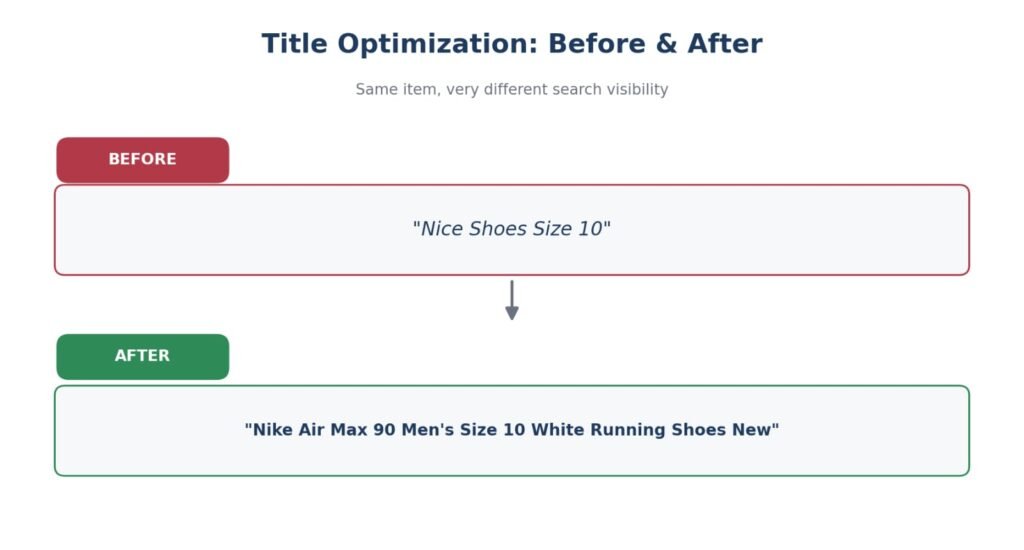
Your title is the single highest-leverage piece of text on your listing. Include the specific keywords buyers actually search for — brand, model, size, color, key features — in a natural order, front-loading the most important terms. Avoid keyword stuffing (repeating the same term multiple times or cramming in irrelevant keywords), since it hurts readability without improving relevance matching.
Item Specifics — Why They Matter
Item specifics are the structured fields (brand, size, material, color, etc.) that let eBay match your listing against filtered searches. A buyer filtering by “Brand: Nike” and “Size: 10” will never see your listing if those fields are left blank — no matter how good your title is. Filling out every relevant item specific field is one of the easiest, most overlooked ranking improvements available. eBay publishes required and recommended item specifics by category, and the list changes periodically — check yours against eBay’s item specifics download before bulk-updating listings
Photos & Listing Quality
High-quality, accurate photos improve both your click-through rate and buyer confidence, both of which feed back into how eBay’s algorithm treats your listing over time. Use multiple angles, a clean background for the primary image, and photos that clearly show any flaws or wear — accurate photos also reduce returns, which protects your seller performance metrics covered in our eBay Top Rated Seller Guide.
Price Competitiveness
Price isn’t just a buyer decision factor — it’s also a ranking signal. Listings priced significantly above comparable, actively-selling items can rank lower in Best Match results. Before pricing a listing, it’s worth running the numbers through our eBay Fee Calculator and eBay ROI Calculator to find a price that’s both competitive and profitable, factoring in shipping costs and eBay’s fees.
Warning Box
Seller performance and listing relevance are evaluated together, not separately. A perfectly optimized title won’t compensate for a high defect rate or late shipping — both sides of the algorithm need attention.
Seller Performance’s Impact on Ranking
Cassini factors in your account-level performance alongside listing relevance — late shipment rate, defect rate, and case resolution history all play a role in how your listings are treated in search. This is the same performance data covered in detail in our eBay Seller Performance, which walks through exactly what eBay tracks and how to improve it.
Promoted Listings vs Organic Ranking
Promoted Listings and organic SEO work together, not as substitutes for each other. Promoted Listings can boost visibility for a fee (see our eBay Promoted Listings Fees guide for the full cost breakdown), but a poorly optimized listing with weak item specifics and a thin title will still underperform even while being promoted. Organic optimization improves the baseline; Promoted Listings adds a paid boost on top of that baseline.
Common Listing Mistakes
Thin, generic titles that don’t include the keywords buyers actually search
Empty or partially filled item specifics fields
Low-quality or insufficient photos
Pricing significantly above comparable actively-selling listings
Ignoring seller performance metrics while focusing only on listing content
eBay SEO Checklist
✔️ Include target keywords naturally in your title
✔️ Fill out every relevant item specific field
✔️ Use multiple high-quality photos
✔️ Price competitively against similar sold listings
✔️ Ship on time and upload tracking promptly
✔️ Keep your defect rate low
✔️ Review and refresh older listings periodically
Frequently Asked Questions
What is eBay SEO?
The practice of optimizing your listings and seller performance so they rank higher in eBay’s own search results, powered by eBay’s Cassini algorithm.
What is Cassini?
Cassini is the name of eBay’s search ranking algorithm, which factors in both listing relevance and seller performance to determine search rankings.
Does Promoted Listings help SEO?
Promoted Listings boosts paid visibility but doesn’t directly improve your organic ranking — the two work alongside each other rather than one replacing the other.
How important are item specifics?
Very — buyers filtering search results by specific attributes will never see your listing if the matching item specific fields are left blank, regardless of title quality.
Do reviews affect ranking?
Seller performance metrics like defect rate and case resolution history are tracked directly by eBay and factor into ranking, separate from buyer reviews shown on your profile.
How often should I update listings?
Periodically reviewing and refreshing older listings — updated photos, corrected item specifics, adjusted pricing — can help keep them competitive against newer, actively-optimized listings in the same category.
Does price affect ranking?
Yes — significantly overpriced listings compared to similar actively-selling items can rank lower in Best Match results.
Can a Store subscription improve visibility?
Store subscriptions themselves don’t directly boost ranking, but they can support better listing management and access to tools that indirectly help maintain strong performance — see Our eBay Selling Fees 2026 for the full comparison.
CTA
Want to check your numbers before you optimize your next listing? Use our eBay Fee Calculator and eBay ROI Calculator to price competitively, and see our eBay Top Rated Seller Guide and eBay Promoted Listings Fees guide for how performance and paid visibility fit into the bigger picture.
Conclusion
eBay SEO isn’t about gaming an algorithm — it’s about giving eBay’s search system every reason to trust that your listing is exactly what a buyer is looking for, and giving your account a performance history that backs it up. Title keywords, complete item specifics, honest photos, competitive pricing, and consistent fulfillment aren’t separate tasks; together, they’re the whole system Cassini is actually measuring
Related Guides
Find the keywords buyers actually search before you write the title.
Photos affect ranking as well as conversion — fix the ones eBay rejects.
Your seller level affects placement too. A perfect listing on a Below Standard account still gets buried.
What paid placement costs, and why it won’t rescue a weak listing.
Copy what’s already selling — titles, specifics and price points.
Muhammad Usman
eCommerce & SEO Specialist
Muhammad works with eBay and marketplace sellers across the UK and US, handling listings, fee structures and store optimisation day to day. He writes these guides because most eBay advice online explains the rule without explaining what to actually do about it.
Every guide here is checked against eBay’s current documentation before publishing and revisited when policies change. More about this site · Get in touch
Written by Muhammad Usman
eCommerce & SEO Specialist with 5+ years of experience in eBay, Amazon, Etsy and TikTok Shop. This guide is based on official eBay documentation and practical seller experience.