Your item sells for £60. The payout says £51.40. Where did the rest go?
That gap is eBay’s fee stack, and it’s more layered than most sellers realise — a percentage on the sale, a flat charge per order, a regulatory fee, VAT on top of the fee itself if you’re a UK business, and optional costs like a Shop subscription or Promoted Listings sitting above all of it.
This guide covers every one of those charges for 2026, with the UK treated properly rather than as an afterthought to US pricing. It matters, because the UK works differently from every other major eBay market: since September 2024, UK private sellers pay no final value fee at all.
If you’d rather skip the reading and see your own numbers, the eBay Fee Calculator does the full breakdown for UK, US, Canada and Australia sales
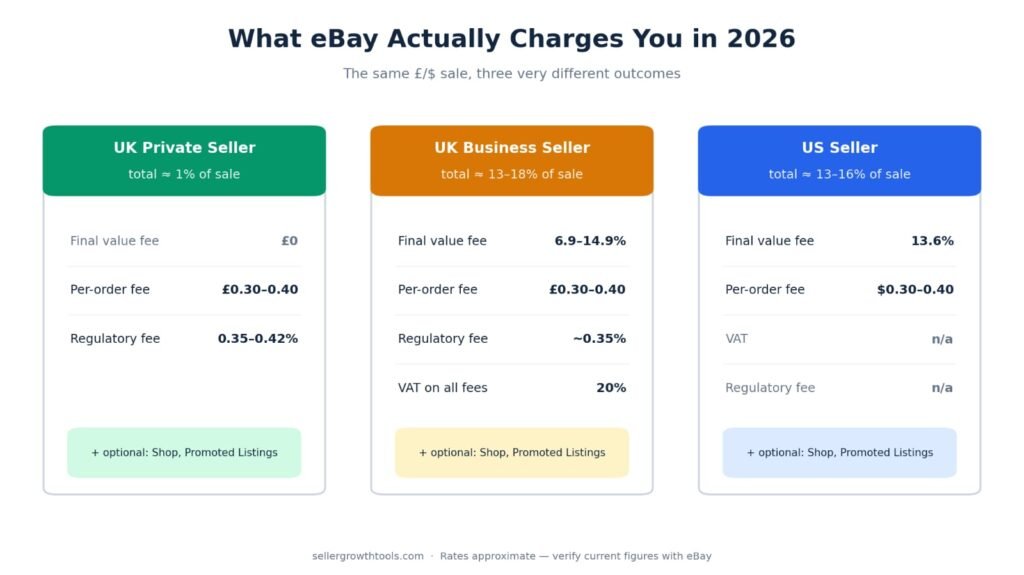
Table of Contents
The Short Answer: What eBay Charges
eBay Selling Fees UK
eBay Selling Fees US
The Final Value Fee Explained
Listing Fees (Insertion Fees)
eBay Shop & Store Subscriptions
Promoted Listings Costs
Managed Payments
Performance Penalties That Raise Your Fees
Business vs Private Seller: What Actually Changes
Worked Examples
How to Reduce Your eBay Fees
Frequently Asked Questions
The Short Answer: What eBay Charges to Sell
eBay charges sellers in five ways. Two are unavoidable, three are optional.
Unavoidable:
Final value fee — a percentage of the total the buyer pays (item + postage + tax). Not charged to UK private sellers
Per-order fee — a flat £0.30 / £0.40 (or $0.30 / $0.40) on each order Not charged to UK private sellers
Optional:
Insertion fee — only once you exceed your free monthly listing allowance
Shop subscription — a monthly fee that buys more free listings and a fee discount
Promoted Listings — an ad rate you set yourself, charged only when an ad drives a sale
For a typical US seller, the total lands somewhere around 13–16% of the sale.
For a UK private seller, its zero on most sales – beacuse the fees simply do not apply to you
For a UK business seller, budget around 13–18% once VAT on fees is included.
That spread is why generic “eBay takes about 13%” advice is unhelpful. Which market you’re in, and which account type you hold, changes the answer completely.
eBay Selling Fees UK
The UK is the outlier, and it’s worth understanding exactly why before anything else.
UK Private Sellers
Since September 2024, private sellers on eBay UK pay £0 in final value fees on most non-Motors listings. eBay moved the cost to the buyer instead, in the form of a Buyer Protection Fee that never touches your payout.
The Buyer Protection Fee: Where the Cost Went
eBay didn’t stop charging for private sales — it moved the charge to the other side of the transaction.
Buyers on eBay UK now pay a Buyer Protection Fee on most purchases from private sellers. It appears at checkout, separate from the item price and postage, and it covers eBay’s Money Back Guarantee on that purchase.
It never touches your payout. The buyer pays it, eBay keeps it, and your net figure is unaffected. It is not deducted from what you receive.
What it does affect is how your listing looks at checkout. The buyer sees a total that’s higher than your asking price, which can make a private listing look less competitive next to a business listing where the fee is built into the price instead.
That’s the trade-off eBay made: private sellers keep essentially all of the sale, but their listings carry a visible extra charge for the buyer.
Does it apply to every sale? It applies to most categories, though some are excluded. eBay Motors works differently.
Can you absorb it for the buyer? No. It isn’t a fee you’re charged, so there’s nothing to absorb. Your only lever is your asking price.
Confirm the current Buyer Protection Fee rate on eBay UK’s official page, as it can change
What a UK private seller still pays:
The per-order fee (£0.30 on orders up to £10, £0.40 above)
A regulatory operating fee of roughly 0.35%–0.42% of the total sale
Insertion fees only if you list more than 300 items in a month
Promoted Listings ad rate, if you choose to use it
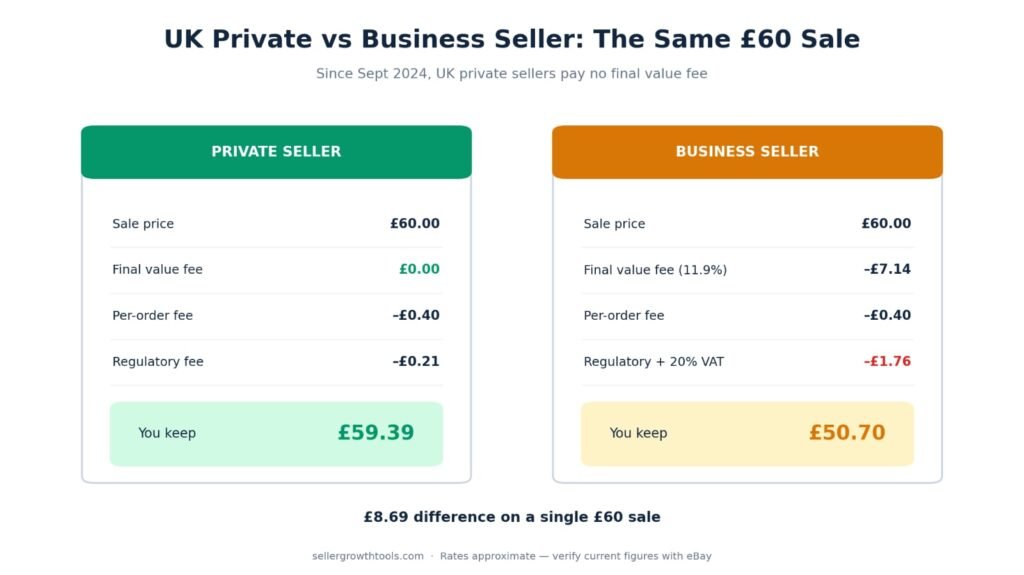
For someone clearing out a wardrobe or selling a few items a month, eBay UK is now close to free. A £45 sale costs you well under a pound in total fees.
UK Business Sellers
Business sellers pay a real, category-based final value fee. The structure:
Charge
| Charge | Typical amount |
|---|---|
| Final value fee | Category-based, roughly 6.9%–14.9% Most everyday categories fall between 9.9% and 13.6% |
| Per-order fee | £0.30 / £0.40 |
| Regulatory operating fee | ~0.35% of the total sale amount |
| VAT on fees | 20% — applied to all the above, including Promoted Listings |
| Fee cap | Maximum final value fee per item is capped |
Verify before you price. eBay UK’s category rates, the regulatory operating fee percentage, and the per-item fee cap all change periodically. Confirm your exact category rate on eBay’s official UK seller fee page before pricing inventory in volume.
UK Final Value Fees by Category
The headline range hides a lot. A collectables seller and a consumer electronics seller are not paying the same rate, and the gap between the cheapest and dearest categories is wide enough to change which products are worth sourcing at all.
| Category | Final value fee | With VAT added |
|---|---|---|
| Clothing, Shoes & Accessories | __% | __% |
| Collectables | __% | __% |
| Trading Cards | __% | __% |
| Consumer Electronics | __% | __% |
| Home & Garden | __% | __% |
| Books, Comics & Magazines | __% | __% |
| Musical Instruments | __% | __% |
| Business, Office & Industrial | __% | __% |
The “with VAT” column is the one that matters for planning, because that’s what actually leaves your account. If you’re VAT-registered you reclaim it later, but it still affects cash flow in the meantime.
Two categories worth calling out: Collectables and Trading Cards have grown enormously on eBay UK, and sellers often move into them from general reselling without checking the rate first. Check yours before you commit to stock.
Rates verified against eBay UK’s official seller fee schedule in September 2026. eBay updates category rates periodically — check the current rate for your category before pricing stock in volume.
The VAT Layer Most Sellers Miss
VAT isn’t applied only to the final value fee. It’s added on top of everything — the final value fee, the per-order fee, the regulatory operating fee, and your Promoted Listings spend.
Here’s what that actually means in practice: a category advertised at 12.9% costs you closer to 15.5% once VAT is included.
If you’re VAT-registered, you reclaim it on your quarterly return and your effective cost drops back toward the headline percentage. If you’re not VAT-registered, that 20% is a genuine, non-recoverable addition.
There’s also a scheme decision worth raising with your accountant: Standard vs Flat Rate VAT Scheme can shift your effective fee cost by 1–2 percentage points. For a business doing meaningful volume, that’s not a rounding error.
UK International Selling Fee
If your buyer is based outside the UK, eBay adds an international selling fee of roughly 1.65% of the total sale amount, on top of your normal final value fee.
This one catches out sellers who deliberately open up international postage to widen their buyer pool — the extra reach is real, but so is the extra cost. Factor it in before you enable worldwide shipping across your whole inventory.
Does a UK Shop Subscription Reduce Your Fees?
Not in the way a US Store does. A UK Shop subscription’s value is in the extra free listing credits and the promotional tools — not a lower final value fee percentage.
For UK private sellers this is obvious enough, since you already pay £0. For UK business sellers it’s the more important point: don’t subscribe to a Shop expecting a fee discount that a US-focused guide promised you. Confirm the current UK Shop terms directly with eBay before subscribing on that basis.
UK Shop Subscription Tiers
The tiers themselves differ from the US Store structure, both in price and in what each level include
| Tier | Monthly cost | Free listings | Best for |
|---|---|---|---|
| Starter | £__ | __ | Branding only — no real saving |
| Basic | £__ | __ | Where most business sellers land |
| Featured | £__ | __ | Consistent high volume |
| Anchor | £__ | __ | Large operations, plus support access |
The same rule applies as in the US: annual billing costs noticeably less than monthly for identical benefits, and Starter is a branding decision rather than a financial one.
For UK private sellers this table is mostly academic — you already pay £0 in final value fees, so a Shop only buys you listing allowance and promotional tools. Your break-even sits much higher than a business seller’s
Shop tiers and pricing verified September 2026. Confirm current tiers and costs on eBay UK’s official Shop subscription page before subscribing.
eBay Selling Fees US
| Category | Final value fee |
|---|---|
| Most categories | 13.6% |
| Books, Movies & Music | ~15.3% |
| Musical Instruments & Gear | ~6.7% |
| Athletic Shoes ($100+) | ~8% |
| Heavy Equipment & Industrial | ~3% |
On sales above $7,500, the rate drops to roughly 2.35% on the portion above that threshold.
Store subscribers from Basic upward get a discount on the final value fee in eligible categories — typically around a percentage point off the standard rate.
Every US sale also carries the flat per-order fee of $0.30 or $0.40.
One thing US sellers underestimate: on cheap items, the flat fee matters more than it looks. On a $15 sale, that $0.40 is an extra 2.7% on top of the percentage — so your real effective rate is nearer 16% than 13.6%. The effect shrinks as prices rise, which is part of why experienced sellers drift toward higher-ticket inventory.
The Final Value Fee Explained
The Detail That Catches People Out
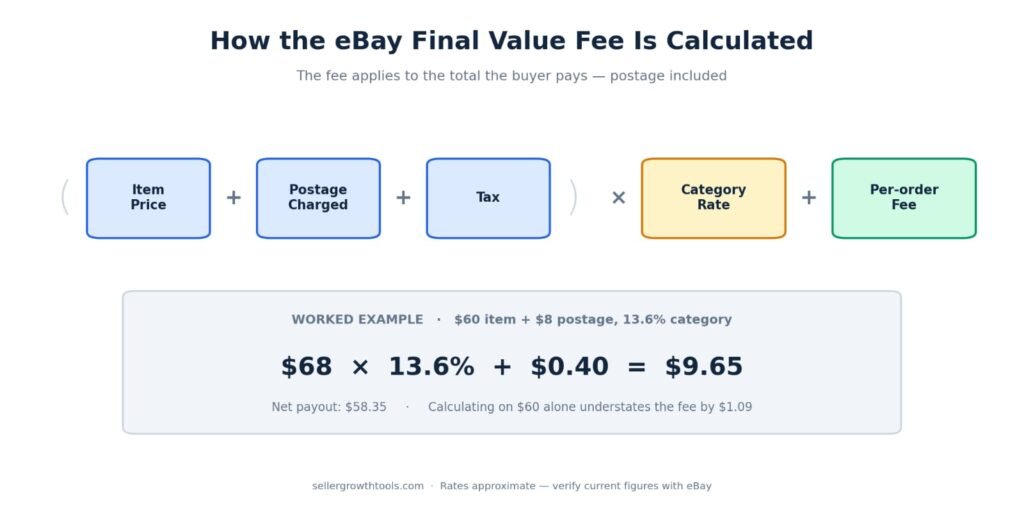
The fee is calculated on the total amount the buyer pays — not the item price alone. Postage is included.
Sell a £30 item with £15 postage, and your fee is calculated on £45, not £30.
This has a practical consequence: shifting cost from item price into postage doesn’t reduce your fee. It’s the same base either way. Sellers who “save on fees” by charging low item prices with high postage are saving nothing.
Worked Calculation
A US seller lists an item at $60 with $8 postage, in a 13.6% category.
Total sale amount: $68
Final value fee: 13.6% of $68 = $9.25
Per-order fee: $0.40
Total charged: $9.65
Net payout: $58.35
Calculate that fee on the $60 item price alone and you’d have underestimated by over a dollar. Across three hundred sales a year, that assumption costs real money.
Listing Fees (Insertion Fees)
| Market | Free listings per month |
|---|---|
| United Kingdom | 300 |
| United States | 250 |
| Canada | 250 |
| Australia | 250 |
Beyond that allowance, an insertion fee applies per listing — around $0.35 in the US, with local equivalents elsewhere.
Beyond that allowance, an insertion fee applies per listing — around $0.35 in the US, with local equivalents elsewhere.
The Rule Most Sellers Get Wrong
The insertion fee is charged when you create the listing, not when it sells. It is non-refundable if the item never sells.
That makes it a different kind of cost to the final value fee. A final value fee is, in a sense, a good problem — you only pay it because you made a sale. An insertion fee can leave you with nothing to show for it.
What Counts Against Your Allowance
Three things burn through allowances faster than people expect:
Per category, not per item. List one item in two categories and that’s two listings.
Relisting counts again. Every relist of an unsold item consumes another slot.
Good ‘Til Cancelled renews monthly. Each automatic renewal is a fresh listing against that month’s count
Is 300 Listings Actually a Lot?
Yes. Hitting 300 listings a month means creating ten new listings every single day. A typical part-time seller lists somewhere between 5 and 40 items a month — nowhere near the ceiling.
This is why so many sellers are surprised eBay charges insertion fees at all. For most of them, in practice, it never applies.
eBay Shop & Store Subscriptions
| Tier | US cost (annual) | Free listings/mo | FVF discount |
|---|---|---|---|
| Starter | ~$4.95/mo | 250 | None |
| Basic MOST SELLERS | ~$21.95/mo | 1,000 | Yes (~0.9pp) |
| Premium | ~$59.95/mo | 10,000 | Yes |
| Anchor | ~$299.95/mo | 25,000 | Yes + support |
| Enterprise | ~$2,999.95/mo | 100,000+ | Yes + bundles |
Monthly billing costs 20–40% more than annual across every tier for identical benefits.
Monthly billing costs noticeably more than annual across every tier — often 20–40% more for identical benefits. Unless you’re genuinely unsure you’ll keep the subscription a full year, annual is the obvious choice.
Two Things Worth Knowing Before You Subscribe
Starter is a branding decision, not a financial one. It gives you the same 250 free listings you’d get without a Store, and no final value fee discount. The savings genuinely start at Basic.
In the UK, a Shop subscription doesn’t cut your final value fee if you’re a private seller — because you already pay £0. For UK private sellers, the only value in a Shop is the extra listing allowance and the promotional tools. That pushes the break-even point much higher than it sits for a US seller on the equivalent tier.
Break-Even Example
A US seller lists 800 items a month with no Store.
250 free, 550 paying $0.35 = roughly $192/month in insertion fees
Move to Basic Store at $21.95/month: all 800 listings fit inside the 1,000 allowance — zero insertion fees — plus the final value fee discount on every sale
At that volume, the subscription pays for itself many times over on insertion fees alone.
| Monthly listings | Recommendation |
|---|---|
| Under 250 | No Shop needed — you’re covered by the free allowance |
| 250–1,000 or £2,000+ monthly sales |
Basic usually breaks even |
| 1,000–10,000 | Premium, once you’re consistently hitting Basic’s ceiling |
| 10,000+ | Anchor, for the allowance and the support line |
The mistake we see most often: sellers jump to Premium or Anchor before their volume justifies it. A higher tier doesn’t make your business more legitimate — it just costs more.
A simple check before upgrading: look at your last three months in Seller Hub. If you didn’t hit your current tier’s ceiling in any of them, it’s too early. eBay lets you change tiers immediately, so you can always upgrade the moment the numbers call for it.
Promoted Listings Costs
Promoted Listings let you pay for visibility. You set your own ad rate — typically 2–20% of the sale price — and it’s charged on top of your final value fee, and only when an ad drives the sale.
The arithmetic gets uncomfortable fast. A 10% ad rate stacked on a 13.6% final value fee means nearly a quarter of your sale price goes to eBay. That can absolutely be worth it for visibility on the right products, but it has to be priced in from the start, not discovered afterwards.
Full breakdown, including the 2026 attribution model change: eBay Promoted Listings Fees.
Managed Payments
eBay handles all payment processing itself, and that cost is already baked into the final value fee. There’s no separate PayPal-style processing charge to calculate on top.
What does affect you is the payout timing — funds move through a processing state before they’re available. Details here: eBay Managed Payments
Performance Penalties That Raise Your Fees
Two surcharges can materially increase what you pay, and both are avoidable.
Below Standard rating — adds up to 6% to your final value fee if your account sits Below Standard for four consecutive months.
High “Item Not as Described” rate — adds roughly 5–6% in affected categories if your INAD return rate is rated Very High.
If both apply, eBay charges only the higher of the two. But either one alone can come close to doubling your effective fee rate. On a 13.6% base, a 6% surcharge takes you to nearly 20%.
This is the cheapest fee reduction available to any seller: keep your metrics clean and you never pay it.
eBay Below Standard Rating Guide — what triggers it and how to fix it
eBay Returns & Refunds — reducing INAD returns
eBay Top Rated Seller Guide — the discount at the other end of the scale.
Both surcharges are driven by the same underlying metrics — defect rate, late shipment rate and tracking validation. Understanding how eBay calculates them is the difference between avoiding a surcharge and discovering it on your invoice. eBay Seller Performance explains what counts against your account and how the monthly evaluation works.
Business vs Private Seller: What Actually Changes
A common misunderstanding: people assume a business account costs more in fees. In the US, Canada and Australia, the final value fee percentage is identical for both account types.
| Private Seller | Business Seller | |
|---|---|---|
| Final value fee (US/CA/AU) | Same | Same |
| Final value fee (UK) | £0 | Category rate + VAT |
| Selling limits | Lower | Higher |
| Shop subscription | Limited access | Full access |
| VAT / tax obligations | Usually none | Required past thresholds |
| Consumer rights duties | Limited | Required by law |
Which One Are You Supposed to Use?
It isn’t a preference — it’s determined by why you’re selling.
Private is for individuals selling items they already own, occasionally. Clearing a wardrobe, selling old electronics, hobby overflow.
Business is for anyone sourcing products specifically to resell — dropshipping, wholesale, retail arbitrage, any consistent income stream.
When to Switch
Consider moving to a business account when:
You’re regularly sourcing items to resell, not clearing out personal belongings
Your sales are approaching your local tax-reporting threshold
You want Shop access for lower per-listing costs at volume
You need higher selling limits (how limits work)
Tax rules vary by country and change over time. In the UK, HMRC expects you to register as self-employed once selling becomes a regular trade rather than occasional personal sales. Verify your own obligations with HMRC or a qualified accountant — this guide is not tax advice.
A note on the UK specifically: because the fee waiver attaches to private-seller status rather than sales volume, there’s an obvious temptation to stay classified as private. Resist it. Sellers who consistently source items to resell are expected to register as a business regardless of volume, and misclassification carries compliance risk entirely separate from the fee question. If it’s genuinely ambiguous which side you fall on, that’s an accountant conversation, not a fee-optimisation one.
Worked Examples
| UK Private Seller — £45 Sale | |
|---|---|
| Sale price | £45.00 |
| Final value fee | £0.00 |
| Per-order fee | –£0.40 |
| Regulatory fee | –£0.16 |
| Net payout | £44.44 |
| UK Business Seller — £60 Sale (Clothing) | |
|---|---|
| Sale price | £60.00 |
| Final value fee (11.9%) | –£7.14 |
| Per-order fee | –£0.40 |
| Regulatory fee | –£0.21 |
| VAT on fees (20%) | –£1.55 |
| Net payout | £50.70 |
If VAT-registered, the £1.55 is reclaimable — bringing the real cost to £7.75.
| US Seller — $80 Item + $10 Postage | |
|---|---|
| Total sale amount | $90.00 |
| Final value fee (13.6%) | –$12.24 |
| Per-order fee | –$0.40 |
| Net payout | $77.36 |
Full Profit Picture — What Actually Matters
| Line | Amount |
|---|---|
| Selling price | $100 |
| eBay fees | –$14 |
| Postage cost | –$8 |
| Product cost | –$45 |
| Net profit | $33 |
This is the number that matters — not your sale price, not even your payout. Work it out before you list, not after. The eBay ROI Calculator handles margin and break-even price.
How to Reduce Your eBay Fees
You can’t negotiate eBay’s rates, but you can lower your effective cost.
Keep your seller metrics clean. Avoiding the Below Standard and High INAD surcharges is worth more than every other tactic on this list combined.
Qualify for Top Rated Seller status. It unlocks a discount on the variable rate in eligible categories.
Check your category rate before pricing. Rates vary far more than sellers assume — from ~3% to over 15%. Don’t miscategorise, but do know what your category actually costs.
Stay inside your free listing allowance. Track active listings and relists monthly. If you’re consistently landing within 20–30 of your limit, either slow your relisting cadence or start comparing Shop subscription numbers.
Get a Shop subscription — but only once volume justifies it. The maths tends to favour upgrading earlier than sellers expect, especially with the fee discount factored in.
Don’t try to shift cost into postage. The final value fee applies to postage too. It’s the same base either way.
Use Promoted Listings selectively. Not on every listing. Stacking a 10% ad rate onto every sale is how margins quietly disappear.
UK sellers: get your seller classification right. The gap between private and business status in the UK is the difference between paying nothing and paying double digits — but classification is a legal question, not a strategic one.
UK business sellers: review your VAT scheme. Standard vs Flat Rate can move your effective fee cost by 1–2 percentage points. Worth an accountant’s half-hour.
Think carefully before enabling worldwide postage on everything. The ~1.65% international fee applies to every overseas sale. On thin-margin items that can be the difference between profit and loss.
Track Your Effective Rate, Not the Headline Rate
The single most useful habit for any business seller: each month, divide your total eBay fees by your total sales. That’s your real, blended rate.
It will almost never match the headline percentage, because your category mix, international sales, Promoted Listings spend and per-order fees all pull it around. Sellers who track this number spot fee creep early. Sellers who assume 13.6% applies evenly across everything find out at year end.
Frequently Asked Questions
How much does eBay charge to sell an item?
For most US sellers, roughly 13–16% of the total sale once the final value fee and per-order fee are combined. UK private sellers pay close to nothing — no final value fee, just a small per-order and regulatory fee. UK business sellers should budget around 13–18% including VAT on fees.
Do UK private sellers really pay no fees?
No final value fee, correct — since September 2024. You still pay the per-order fee and a small regulatory operating fee, so it isn’t quite zero, but on a £45 sale the total is under a pound.
Does eBay charge fees on postage?
Yes. The final value fee is calculated on the total amount the buyer pays, including postage and applicable tax.
Do I pay a listing fee on eBay?
Only if you exceed your monthly free allowance — 300 listings in the UK, 250 in the US, Canada and Australia. Most casual and part-time sellers never pay one.
Is an eBay Shop worth it?
Under 250–300 listings a month, probably not. Past that, or once you’re at £2,000+ in monthly sales, Basic usually breaks even on insertion fee savings alone. UK private sellers should note there’s no fee discount to gain, so the break-even sits higher.
Does a business account pay higher eBay fees?
Not in the US, Canada or Australia — the percentage is identical. In the UK, yes: private sellers pay £0 while business sellers pay a category rate plus VAT.
Are payment processing fees separate?
No. Managed Payments processing is already included in the final value fee. There’s no additional PayPal-style charge.
What’s the cheapest eBay Store tier?
Starter. But it gives you the same free listing allowance as no Store at all and no fee discount, so it’s a branding choice rather than a saving.
Can my eBay fees go up?
Yes — a Below Standard rating for four consecutive months adds up to 6%, and a Very High INAD rate adds 5–6% in affected categories.
Can I switch from private to business later?
Yes. eBay lets you convert your account as your selling activity grows, and it’s a normal step once occasional selling becomes a regular income stream.
Does eBay charge extra for international sales?
In the UK, yes — roughly 1.65% of the total sale amount when your buyer is based outside the UK, on top of your normal final value fee.
Does VAT apply to all eBay fees or just the final value fee?
All of them. VAT is added to the final value fee, the per-order fee, the regulatory operating fee and your Promoted Listings spend. It’s reclaimable if you’re VAT-registered.
How do I work out my real eBay fee rate?
Divide your total monthly eBay fees by your total monthly sales. That blended figure is your true rate, and it will rarely match the headline percentage for your category.
The fee that determines your profit is almost always the final value fee — not the listing fee, not the Shop subscription. Get your category rate right, keep your seller metrics clean, and only subscribe to a Shop once your volume genuinely calls for it.
And if you’re selling privately in the UK, understand how unusual your position is right now. No other major eBay market waives its main selling fee for individual sellers.
Work out your real payout before you list:
eBay Fee Calculator · eBay ROI Calculator
SELLERGROWTHTOOLS · FREE TOOLS
Stop estimating. Run your numbers.
Final value fee, per-order fee and net payout for any price — UK and US. Then work out whether the item was worth sourcing at all.
eBay Fee Calculator ROI CalculatorRelated Guides
More on what eBay charges, and how to keep more of what you sell.
OTHER COSTS TO ACCOUNT FOR
LOWER WHAT YOU PAY
PRICING AND SELLING
All free tools · All guides · About · Contact
Last updated: September 2026
Reviewed against: Official eBay Seller Fee schedules (UK & US)
Fee rates change without much notice and vary by category. Confirm your specific category rate on eBay’s official seller fee page before pricing inventory in volume.
|
MU
|
Written by Muhammad Usman eCommerce Specialist · eBay Seller & SEO Expert Muhammad manages eCommerce operations and SEO for UK sellers across eBay, Etsy, Shopify and TikTok Shop. He built SellerGrowthTools to give sellers the fee and profit numbers they need before they list, not after. |